

 English
 عربى
عربى 简体中文
简体中文
Home / News / Industry News / Thin Gauge Thermoforming Guide: Process, Materials, and Machine Selection

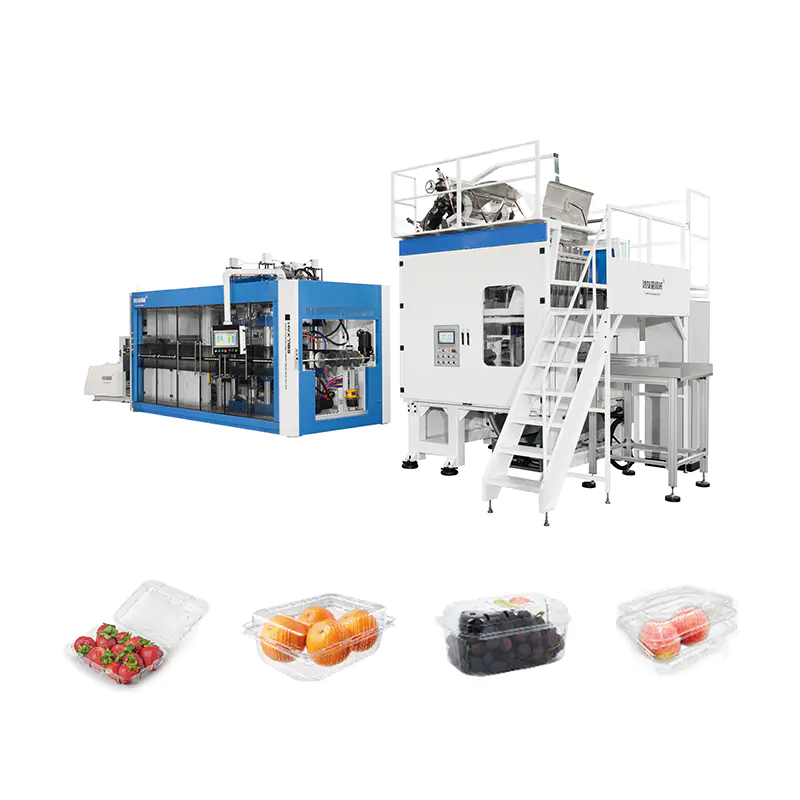
One of the most common reasons a thin-gauge packaging line underperforms is a mismatch between the forming machine and the sheet thickness. A 0.6 mm PET sheet requires a different temperature profile, pressure, and plug speed than a 1.2 mm PP sheet. Run the wrong combination and you get wall thinning at the corners, webbing in the draw areas, or warped parts that fail quality inspection. The conclusion is clear: selecting a machine with the right forming pressure range, multi-zone heating, and sheet handling control is the fastest way to improve yield and cut cycle time.
Key takeaway: In thin-gauge thermoforming, the material, the forming method, and the machine must work as one system. If any one of them is off, output quality and cost efficiency suffer.
Thin gauge thermoforming is a plastic forming process that heats a sheet thinner than 1.5 mm (0.060 inches) to a pliable state, then shapes it using vacuum, air pressure, or a combination of both. Unlike heavy-gauge forming, which focuses on structural strength, thin-gauge forming targets lightweight, high-rotation-volume parts.
The production sequence is straightforward:
Typical products include fruit packaging boxes, ready-meal trays, blister packs, medical device trays, and cup and lid components. The common feature is a requirement for high output per unit time while keeping part weight low.
Material selection drives both process stability and the performance of the final part. The most commonly used thin-gauge resins are:
| Material | Thickness Range (mm) | Advantages | Typical Applications |
|---|---|---|---|
| PS (Polystyrene) | 0.2-1.5 | Low cost, easy to form | Food trays, cups, blister packs |
| PP (Polypropylene) | 0.3-1.5 | Chemical resistance, microwave safe | Ready-meal trays, food containers |
| PET (Polyester) | 0.2-1.0 | Clarity, impact strength, food-safe | Clear containers, salad trays |
| PVC | 0.2-1.2 | Versatile, moderate cost | Blister packs, clamshells |
| PLA (Polylactic Acid) | 0.2-1.0 | Compostable, renewable source | Eco-friendly food packaging |
When comparing resins, do not base the decision on raw material price alone. Yield rate, formability at the target thickness, food-contact approval, and the ability to hold dimensional consistency over long runs are equally important to the real cost per finished part.
Key selection criteria to review:
The forming method determines how precisely the heated sheet follows the mold surface. In thin-gauge packaging, three approaches are commonly evaluated.
Vacuum forming draws the heated sheet into the mold cavity by creating negative pressure. It is a low-cost entry point and works reliably for shallow trays and simple geometries. However, vacuum alone cannot produce sharp corners or fine embossed detail, and wall distribution at corners tends to be uneven.
Pressure forming applies positive air pressure, typically 3-6 bar, from the opposite side of the heated sheet. The added force delivers sharper corners, finer surface detail, and more consistent wall thickness. Pressure forming is preferred for medical and cosmetic packaging where appearance and tight tolerances matter.
Advanced machines combine positive and negative pressure in one forming station. The sheet is pre-stretched, either by a blowing step or a mechanical plug, before vacuum pulls it into the cavity. This reduces material stress and makes deeper draws realistic without webbing. It is especially effective for cups, bowls, and containers with a depth-to-width ratio above 1:1.
For a deeper look at how this works, read our article on positive and negative pressure integration in thin-gauge forming.
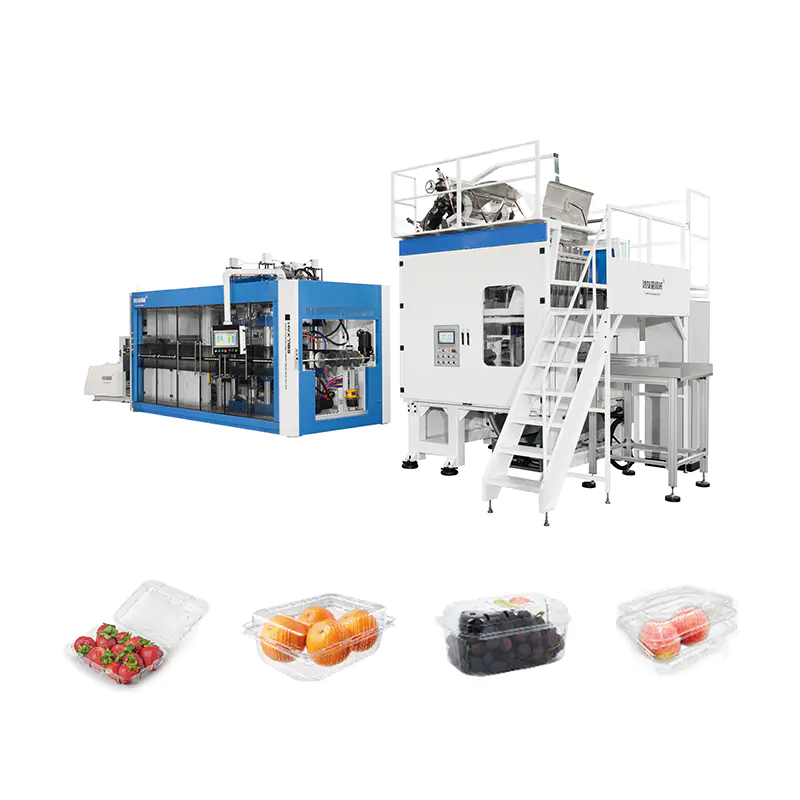
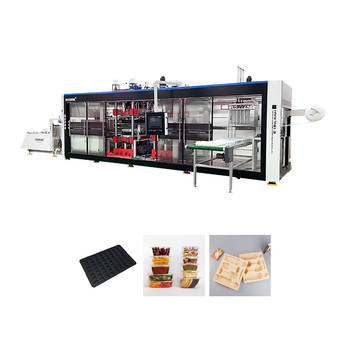
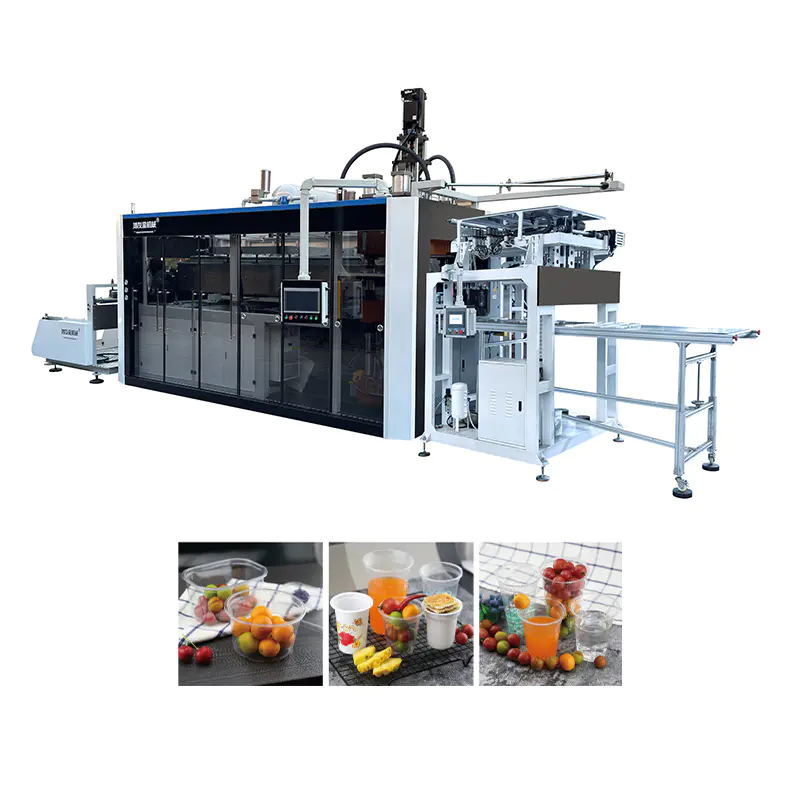
HYX7161 fully automatic positive and negative pressure 3-station thermoforming machine is a production platform built around this principle, combining a 3-station layout with precise pressure control for thin-gauge applications.
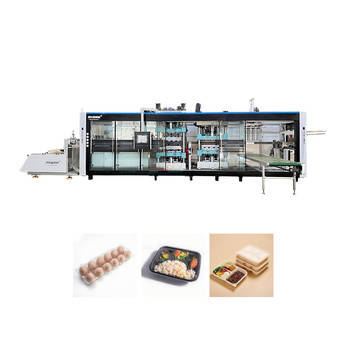
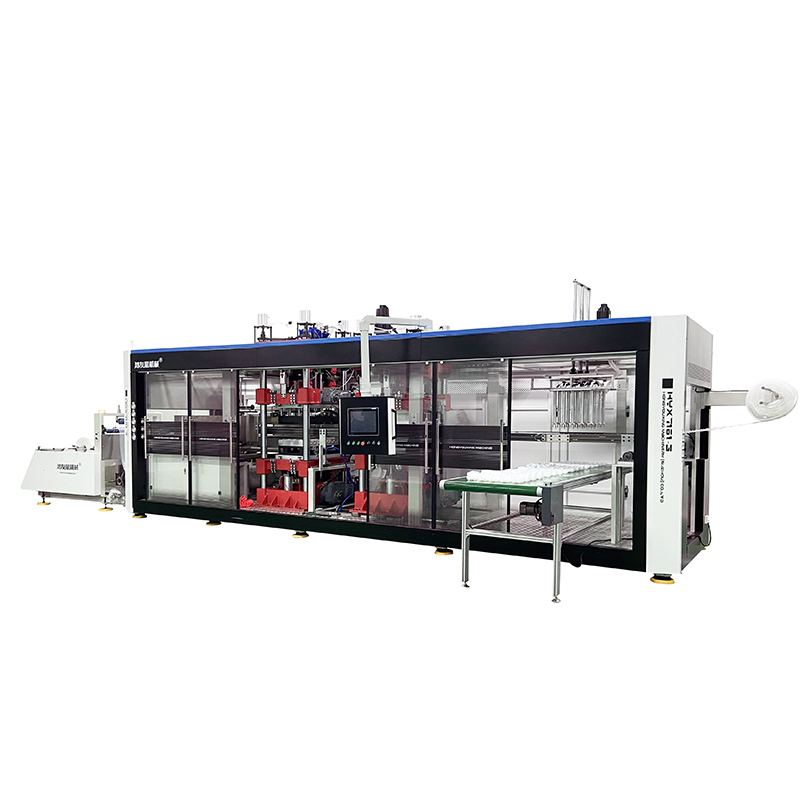 Fully Automatic 3-Station Thermoforming Machine for Thin-Gauge PackagingThis machine combines a three-station layout with precise positive and negative pressure control, ideal for thin-gauge thermoforming. It supports servo stretching, intelligent temperature control, and quick mold changes, making it well-suited for producing trays, blisters, and cup lids.View Product →
The machine specification matters more than any other single factor when adopting thin-gauge thermoforming. The following parameters carry the most weight.
Thin sheet is prone to sagging when heated. Look for servo-driven gripper rails that maintain consistent tension from the heating tunnel through the forming station. Loose sheet is the leading cause of webbing and unequal wall distribution.
Heat distribution across the sheet width must be adjustable in independent zones. Thin sheets in the 0.2-1.0 mm range are especially sensitive to heater edge effects. Independent zone control lets the operator compensate for heat loss near the clamps and hold a more uniform forming temperature.
If the product line requires sharp details, confirm the machine can deliver at least 3 bar of positive pressure. Equipment rated for 5-6 bar provides a useful safety margin and broadens the range of parts you can run without tooling changes.
Integrated trimming eliminates a separate die-cutting operation. On a high-volume line, this is a measurable reduction in labor and material handling. A machine with a horizontal trimming unit can cut a web of formed parts and trim them in one pass.
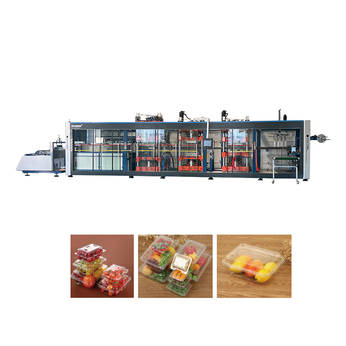
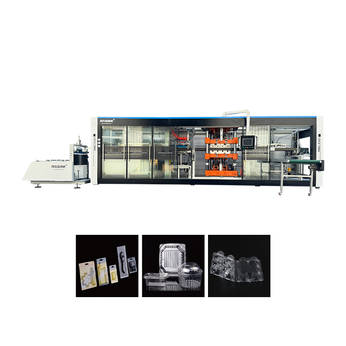
High-speed automatic thermoforming machine with horizontal trimming addresses both cycle time and post-forming efficiency in a single system.
 High-Speed Thermoforming Machine with Horizontal Trimming for PackagingIntegrated with horizontal trimming, this high-speed system reaches up to 35 cycles per minute using servo drives and a Beckhoff control system. It handles forming, cutting, and stacking efficiently, with quick mold change and safety features, suitable for products like berry boxes and flowerpots.View Product →
Servo drives deliver repeatable motion and precise control over plug stroke, forming pressure, and station timing. For long production runs, servo automation reduces cycle-to-cycle variation and simplifies integration with upstream and downstream equipment.
Thin-gauge thermoforming supports nearly every segment of consumer and industrial packaging. The key industries include:
Fruit boxes, ready-meal trays, cake packaging, and drink cups are the highest-volume segment. The typical resins are PP, PET, or PS, selected based on whether the product needs oven resistance, cold-chain tolerance, or transparency. The push toward material reduction is driving formers to thinner gauges that use less resin while preserving rigidity.
Full servo motor drive cup lid bowl thermoforming machine is designed for this segment, combining servo precision with the positive/negative pressure forming needed for stable thin-gauge containers.
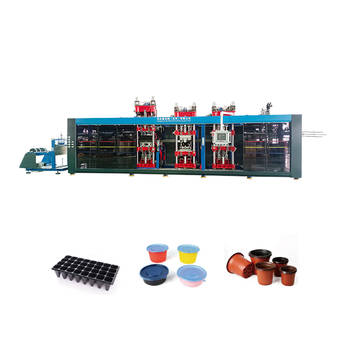
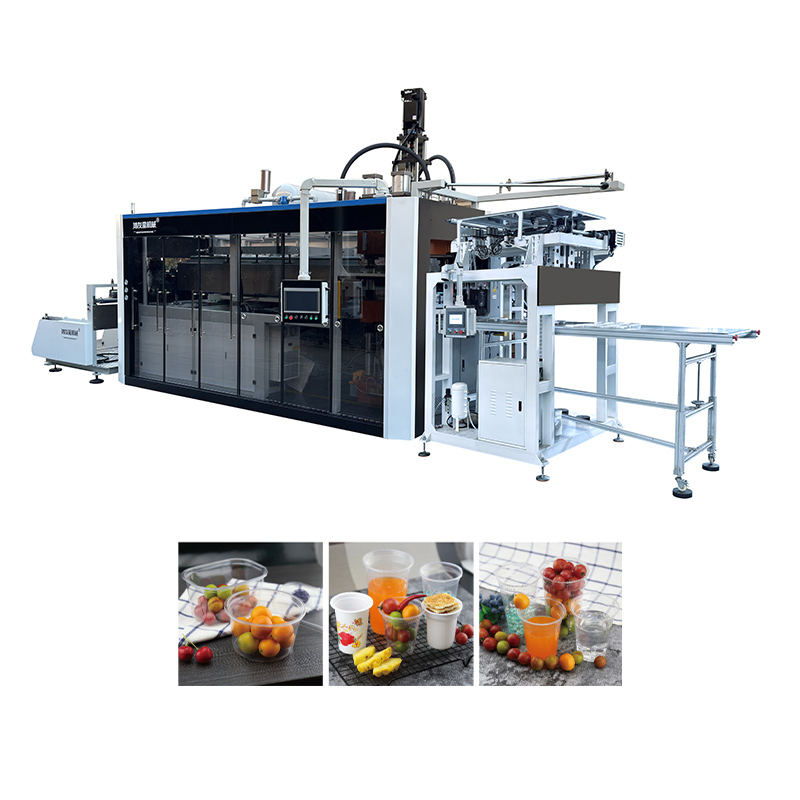 Full Servo Motor Thermoforming Machine for Cups, Lids, and BowlsDesigned for thin-gauge containers, this full servo machine features servo-driven plug assist, film feeding, and stretching, plus hydraulic die table and precise PLC temperature control. Its side mold changing car and quick change capability streamline production, making it ideal for cups, lids, and bowls.View Product →
Blister packs for tablets and sterile trays for surgical instruments require clean, accurate, and consistent forming. PVC and PET are the standard resins here. The machine must support flash-free cutting and repeatable sheet indexing to meet hygiene and dimensional requirements.
Read about medical vacuum packaging to see how thin-gauge thermoforming is applied in pharmaceutical and healthcare environments.
Anti-static trays for circuit boards, component packs, and hardware tools are commonly formed from HIPS with anti-static additives. The target is a lightweight tray that protects the product without adding shipping weight.
Display trays, inserts, and sample packs use pressure forming to reproduce fine details and textured surfaces that improve shelf appeal. PET and PVC are the typical choices for these parts.
The most common quality defects in thin-gauge thermoforming are largely preventable when the process parameters and machine capabilities match the material and part geometry.
Symptom: folds or material bridges in deep draw areas.
Symptom: corners and vertical walls are thinner than the base.
Symptom: the finished part does not sit flat.
For dimensional reference, a well-cooled pressure-forming setup with a high-quality aluminum mold typically holds critical dimensions to ±0.1 mm. Vacuum forming alone is usually closer to ±0.3 mm on the same part. If your application requires tight tolerances, plan the process around pressure forming or positive/negative pressure integration.
The standard industry threshold is sheet thickness below 1.5 mm (0.060 inches). Thin-gauge thermoforming covers a practical range from approximately 0.2 mm to 1.5 mm. The lower limit depends on the material melt strength and the machine sheet handling capability.
Polystyrene (PS/HIPS) is traditionally the easiest resin to run, offering an excellent balance of cost, formability, and mold release. Polypropylene is also common, especially for food containers, but it requires a wider temperature window and more precise heat control.
Yes. With positive/negative pressure forming and a draw ratio of up to 3:1, PP and PET can form cups and bowls that closely match injection-molded containers in appearance. The two limiting factors are the material elongation at break and the machine pre-stretching capability.
High-speed packaging lines run between 20 and 40 cycles per minute. Cycle time depends on part size, material, and mold cooling capacity. Smaller parts such as lids and cups can reach 40 cycles per minute or more on a full-servo machine.

 +8618621972598
  +8613917961988
  [email protected]
 No. 565, Xinchuan Road, Xinta Community, Lili Town, Wujiang District, Suzhou City, China
 Copyright © 2024 Thermoforming Machine/Plastic Cup Machine All Rights Reserved.Custom Automatic Vacuum Thermoforming Plastic Machine Manufacturers