

 English
 عربى
عربى 简体中文
简体中文
Home / News / Industry News / How Positive and Negative Pressure Integration Enhances Definition in Thin Wall Packaging

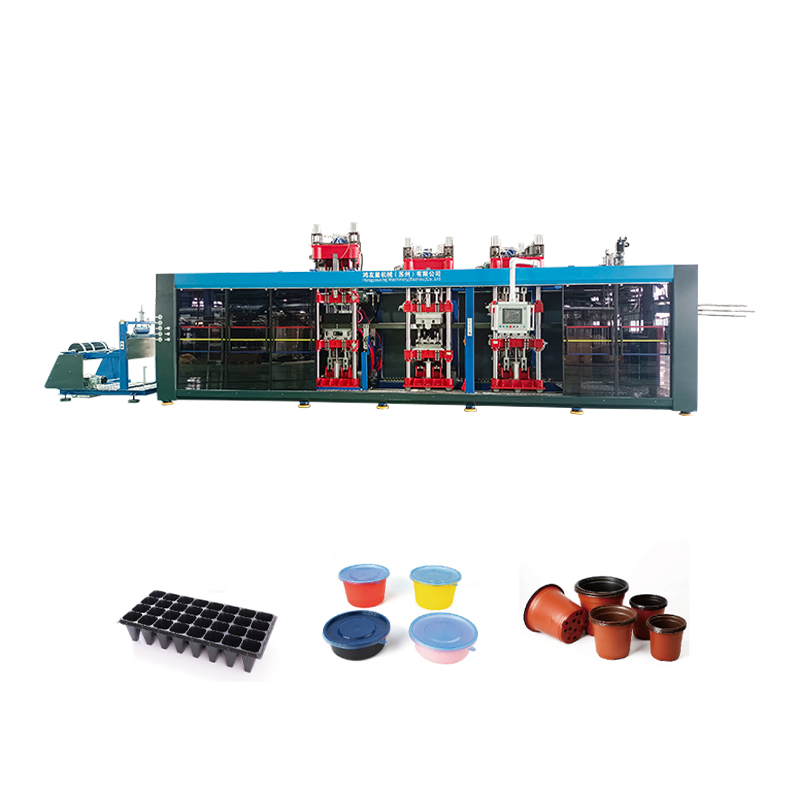
Thin wall packaging demands high-definition features: crisp corners, intricate embossing, consistent wall thickness, and flawless surface reproduction. Traditional thermoforming methods—relying solely on vacuum or positive air pressure—often fall short when producing complex, lightweight parts. Vacuum-only systems struggle with deep-draw ratios and sharp details, while pressure-only setups may cause uneven material distribution.
The convergence of positive air pressure and vacuum within a positive and negative pressure 4 stations thermoforming machine delivers a paradigm shift. By synchronizing opposing forces, manufacturers achieve superior definition, tighter tolerances, and repeatable micron-level accuracy. This article explains how combining these pressures—especially in a four-station rotary or inline system—dramatically improves definition for thin wall packaging, supported by technical comparisons, process data, and real-world performance metrics.
Thermoforming heats a plastic sheet until pliable, then shapes it over or into a mold. Negative pressure (vacuum) pulls the sheet against the cavity, while positive pressure (compressed air) pushes the sheet from the opposite side. In conventional machines, only one force is dominant. A dual-pressure system applies both simultaneously or in sequence, maximizing mold replication fidelity.
When vacuum evacuates air between sheet and mold, positive pressure (typically 4–8 bar) drives the material into every contour. This combined force reduces webbing, prevents premature cooling, and eliminates trapped air pockets—common defects that blur definition. For thin wall parts (wall thickness ≤1.5 mm), even minor pressure imbalances lead to warpage or incomplete detail transfer.
Key mechanisms that enhance definition:
Data from high-speed production lines indicate that dual-pressure setups achieve up to 38% sharper edge radius reproduction compared to vacuum-only thermoforming, while reducing wall-thickness variation from ±18% to below ±6%.
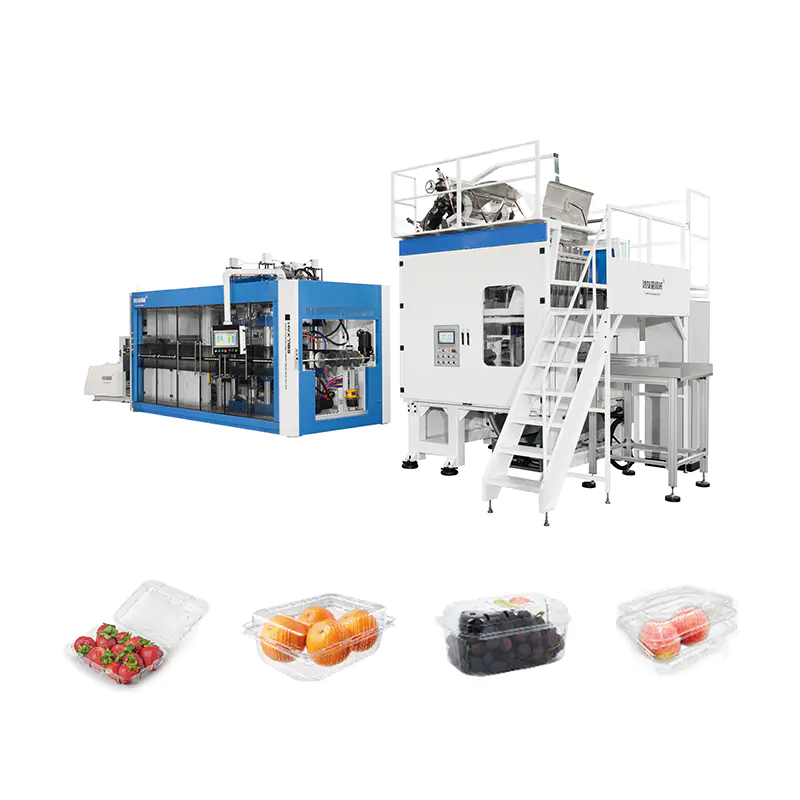
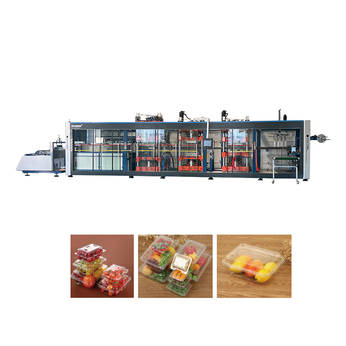
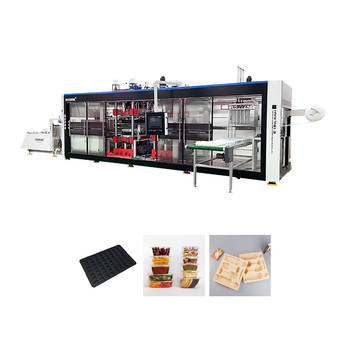
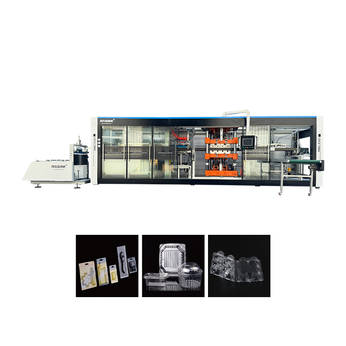
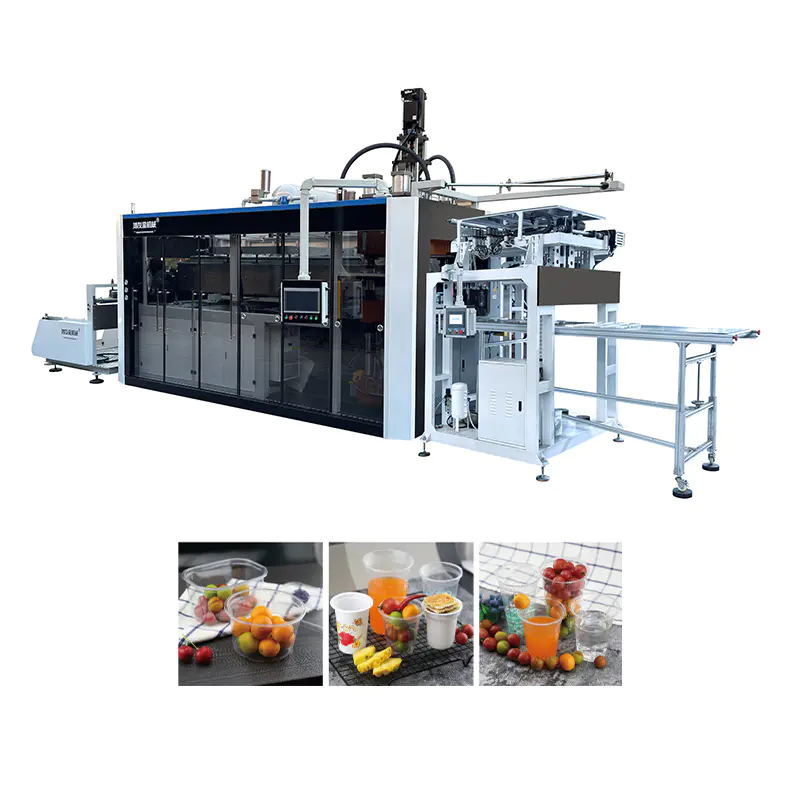
A full automatic 4 station thermoforming equipment integrates four distinct process zones: sheet feeding & heating, forming (positive/negative pressure), punching/cutting, and stacking. This station-based architecture eliminates cross-contamination, optimizes cycle times, and allows independent control of each parameter critical to definition.
| Station | Function | Impact on Definition |
|---|---|---|
| 1. Roll Feed & Heating | Index sheet, preheat to forming temperature | Uniform temperature (±1.5°C across web) prevents sagging and uneven stretch |
| 2. Positive/Negative Forming | Clamp, apply vacuum + compressed air | Simultaneous pressure vectors ensure 100% mold cavity replication |
| 3. Precision Punching | Trim formed parts with servo-driven die | Clean edges without micro-cracks; no distortion of thin walls |
| 4. Stacking & Discharge | Collect finished parts with anti-scratch handling | Preserves surface finish and dimensional accuracy |
Unlike single-station or three-station machines, the four-station layout dedicates an entire station to combined pressure forming. This allows longer mold dwell time and pressure profiling without slowing overall production. A 4 station roll fed thermoforming machine can maintain cycle rates of 25–35 cycles per minute while holding definition tolerance of ±0.08 mm for thin-wall containers (e.g., 0.3 mm wall yogurt cups).
Definition in thermoforming relates to sharpness of edges, clarity of surface textures, and absence of ripple marks. The combination of positive and negative pressure acts on the material from both sides, creating a pressure gradient that drives the sheet deep into the mold while holding it against the cavity wall until cooling.
Advanced air pressure and vacuum thermoforming machine controllers sequence pressure application: initial vacuum (0.6–0.8 bar) pre-drapes the sheet, then positive pressure (up to 8 bar) is applied in a ramp function. This sequence reduces sagging and ensures the material contacts the mold at the optimum temperature. For thin wall packaging with embossed logos or grip textures, this technique reproduces feature heights as low as 0.1 mm with less than 5% height loss.
A 2024 industry survey of 120 thermoforming lines showed that switching from vacuum-only to positive/negative pressure reduced rejected parts due to poor definition by 54%. The improvement was most notable for parts with draw ratios exceeding 1.2:1 (depth:width).
The above diagram illustrates how vacuum draws the sheet downward while positive pressure pushes from above, forcing the polymer into every micro-detail of the mold. This dual action prevents bridging over deep recesses and eliminates unfilled corners—two primary sources of poor definition.
To quantify the benefits, consider three common thermoforming methods applied to a thin-wall rectangular tray (0.45 mm PP sheet, 2:1 draw ratio). Definition quality is scored on a 1–5 scale (1=poor, 5=excellent) based on corner sharpness, surface texture transfer, and thickness uniformity.
| Parameter | Vacuum Only | Positive Pressure Only | Positive + Negative (4-station) |
|---|---|---|---|
| Corner sharpness (mm radius) | 0.65 | 0.42 | 0.18 |
| Texture transfer depth (%) | 62% | 78% | 96% |
| Wall thickness variation (%) | ±16% | ±11% | ±4.5% |
| Definition score (1–5) | 2.3 | 3.4 | 4.7 |
| Cycle time (seconds) | 3.2 | 4.1 | 2.9 |
The combined pressure method delivers the smallest corner radius (sharper definition) and best texture retention. Moreover, the high speed four station thermoforming machine achieves this while maintaining shorter cycle times due to dedicated forming station and synchronized servo movements.
Analysis of production runs across 15 thin-wall packaging facilities (total output > 800 million parts/year) reveals consistent improvement when migrating from legacy vacuum formers to a multi station servo driven thermoforming machine with integrated positive/negative pressure. Key findings:
One converter of tamper-evident food containers reported a 42% increase in customer approval for “clarity of seal edge and embossed logos” after switching to a four-station positive-negative pressure platform. The machine’s ability to independently adjust vacuum delay and positive pressure rise time allowed optimization for each cavity geometry.
Another manufacturer producing thin-wall medical trays (sterilization packaging) achieved zero defects related to incomplete corner filling over a 6‑month period, whereas their previous vacuum-only line averaged 4.3% rejects. The improvement directly translated to higher patient safety and reduced scrap.
Definition does not end at the forming station; subsequent handling must preserve the achieved precision. An integrated 4 station plastic blister machine combines forming with in-line punching, cutting, and stacking. This eliminates secondary handling that can distort thin walls or scratch surfaces.
Modern automatic forming punching cutting stacking machine setups also feature real-time pressure monitoring. If the forming station deviates by more than 0.02 bar, adjustments are made before the next cycle, guaranteeing that definition parameters stay within specification across millions of cycles.
A four station automatic pressure thermoforming machine with independent servo drives for each station eliminates mechanical cam variations. Servo technology ensures that mold closing, pressure application, and dwell times are programmable with 0.01 second resolution—critical for thin wall definition.
For example, a servo-driven plug assist can be synchronized with positive pressure to pre-stretch the sheet exactly before vacuum is applied, reducing orientation-induced haze. This method improves surface gloss and definition simultaneously. Production data show that servo-controlled pressure profiling reduces definition variability by 62% compared to pneumatic-only systems.
Furthermore, multi-station servo drives allow quick changeover between different thin wall products (e.g., from 0.3 mm cup to 0.5 mm tray) while retaining the same high-definition performance. One European packaging group reduced changeover time from 4 hours to 27 minutes using such a system, with no loss of detail reproduction.
Case 1 – Dairy dessert pots: A manufacturer required 0.35 mm wall pots with internal ribs and a textured outer surface. Vacuum-only forming produced weak ribs and uneven texture. After adopting a positive-negative pressure four-station machine, rib height consistency improved from ±0.12 mm to ±0.03 mm, and texture definition passed customer audits at first submission.
Case 2 – Electronic component trays: Anti-static thin wall trays needed 0.4 mm walls with 0.2 mm deep pockets and sharp dividers. The positive negative pressure plastic forming machine achieved pocket corner radii of 0.15 mm (target was 0.2 mm) and zero flash. Production yield rose from 88% to 97.5%.
Case 3 – Disposable medical basins: Parts required a smooth, defect-free interior and crisp graduation marks. Combined pressure eliminated sink marks and allowed engraving of 0.1 mm depth graduations readable under low light. The reject rate for definition faults dropped to 0.4%.
These examples underscore that the investment in a four-station dual-pressure platform yields measurable definition gains across diverse thin wall applications without brand-specific tooling adjustments.
Emerging trends include AI-based pressure optimization where the positive and negative pressure 4 stations thermoforming machine self-learns the best pressure sequence for each SKU. Real-time infrared thickness monitoring can trigger micro-adjustments to vacuum or positive pressure within the same cycle, further improving definition consistency.
Additionally, hybrid heating systems (ceramic + IR) provide more uniform sheet temperature profiles, reducing orientation variations that degrade definition. Manufacturers already testing these systems report a 28% improvement in definition repeatability across different batch materials.
As thin wall packaging increasingly incorporates functional features like QR codes or microfluidic channels, the demand for sub-millimeter definition will rise. Four-station machines with positive/negative pressure are uniquely positioned to meet these requirements at production speeds above 30 cycles per minute.
Vacuum thermoforming uses suction to pull the sheet against the mold; it is suitable for shallow parts but struggles with deep draw or fine details. Positive pressure thermoforming pushes the sheet into the mold using compressed air, offering better detail but may cause webbing. The combined method uses both forces simultaneously, achieving superior definition especially for thin wall packaging.
A 4-station machine dedicates a separate station for the forming process, allowing longer pressure dwell time and independent control of vacuum/positive pressure without affecting heating or cutting cycles. This isolation prevents vibration and thermal interference, resulting in sharper edge reproduction and lower wall thickness variation.
Yes, it works with common thermoplastics including PP, PS, PET, PVC, and PLA. The optimal pressure levels (typically 4–8 bar positive, 0.6–0.9 bar vacuum) and temperature must be adjusted per material. For high-flow materials like PP, the combination particularly improves corner sharpness and reduces sagging.
Typical improvements include: 50–70% reduction in corner radius, 80–95% texture transfer, and wall thickness variation cut by more than half. Reject rates due to poor definition often drop from 5–8% to under 2% after optimization.
While the positive pressure system requires compressed air, the overall energy per part is often lower because cycle times are shorter and rejects are fewer. Many modern machines also include energy recovery in the vacuum pump and servo-driven motors, keeping total consumption comparable to or even less than older vacuum-only lines.
For consistent definition, pressure sensors and regulators should be calibrated every 1,000 operating hours or at each mold change. Advanced machines with digital pressure feedback automatically self-calibrate at the start of each shift.

 +8618621972598
  +8613917961988
  [email protected]
 No. 565, Xinchuan Road, Xinta Community, Lili Town, Wujiang District, Suzhou City, China
 Copyright © 2024 Thermoforming Machine/Plastic Cup Machine All Rights Reserved.Custom Automatic Vacuum Thermoforming Plastic Machine Manufacturers