

 English
 عربى
 简体中文
Home / News / Industry News / Dimensional Accuracy in Thermoformed Products: Key Factors & Tolerances

A lidding line stops because a packaging tray flange is 0.4 mm out of pitch. An automotive interior panel fails its assembly audit because a locating hole drifts 0.3 mm. In both cases the defect looks small, but the cost is not: rework, rejected batches, and lost output. Dimensional accuracy in thermoformed products is rarely an accident. It is the result of material behavior, mold quality, and machine repeatability, and each of these factors can be controlled once you know where they act.
This article explains the main sources of dimensional deviation in thermoforming, the tolerances you can realistically specify, and the equipment and tooling decisions that decide whether a part holds its dimensions from the first run to the thousandth.
Dimensional accuracy is the difference between the measured geometry of a formed part and its design intent under defined conditions. In practice, buyers discuss tolerances in two ways: as an absolute value, such as ±0.50 mm on a flange width, or as a percentage of the nominal dimension, such as ±0.5% of a 300 mm length. Both describe the same physical reality, but percentages are easier to compare across different part sizes.
Shrinkage is the largest and most predictable source of deviation. When the hot sheet is formed and cooled to room temperature, every polymer contracts. The amount depends on the material, the mold temperature, the cooling rate, and the stiffness of the part. The table below summarizes shrinkage ranges that thermoforming processors normally expect from common sheet materials.
| Material | Typical shrinkage range | Common applications |
|---|---|---|
| HIPS | 0.3–0.6% | Packaging trays, blisters, disposables |
| PP | 1.5–2.0% | Food containers, cups, lids |
| PET | 0.3–0.7% | Clamshells, display packaging |
| PVC | 0.3–0.5% | Blisters, industrial covers |
| PE | 1.5–3.0% | Heavy-gauge trays, tanks, liners |
Semi-crystalline materials such as PP and PE not only shrink more than amorphous PS and PVC; they are more sensitive to cooling rate. Two parts from the same PP sheet can differ simply because one was cooled on a warmer mold. If the product has tight dimensional requirements, material selection is the first and most economical control point.
After material selection, the forming process decides how closely the part reproduces the mold. Four stages matter most: sheet conditioning, heating, forming, and cooling.
The forming sheet must reach the heating station with controlled thickness and moisture. A sheet that is 10% thicker on one edge stretches differently, which shifts trimming and sealing positions. Hygroscopic materials such as PET and polyamide absorb moisture from ambient air; the resulting steam bubbles create local thin spots and distorted flanges. Storing rolls under stable conditions is a low-cost way to protect dimensional consistency.
Heating turns a flat sheet into a pliable membrane. If the temperature profile is patchy, the hottest zones sag first, the sheet thins unevenly, and wall-thickness variation appears in predictable places. Multi-zone infrared heaters with individual control are therefore a standard feature on precision thermoforming machines, and sag control depends on the timing between heating and forming.
Vacuum forming uses atmospheric pressure of about 100 kPa, which is sufficient for shallow blisters but limited for deep or textured geometry. Positive air pressure above the sheet multiplies the forming force and reproduces fine detail such as sharp corners, embossed lettering, and narrow ribs. Plug assist gives the sheet a mechanical pre-stretch so the final pressure does not have to pull material from distant areas.
For thin-gauge products, the difference between vacuum-only and positive-and-negative pressure forming shows in corner thickness and in how stable flange dimensions stay across a long run. Positive and negative pressure integration in thin-gauge thermoforming explains this mechanism in more detail.
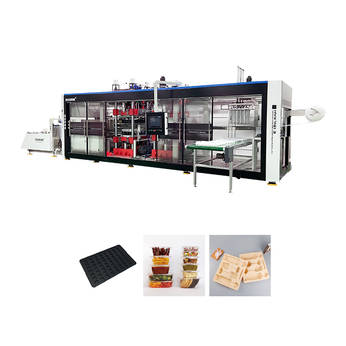
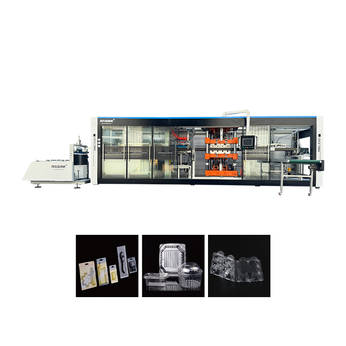
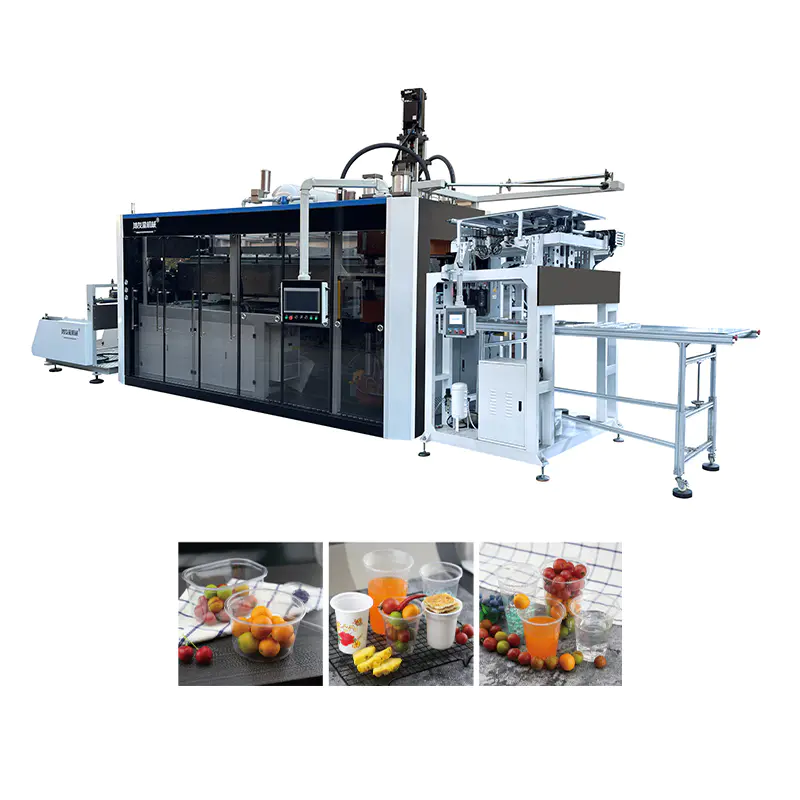
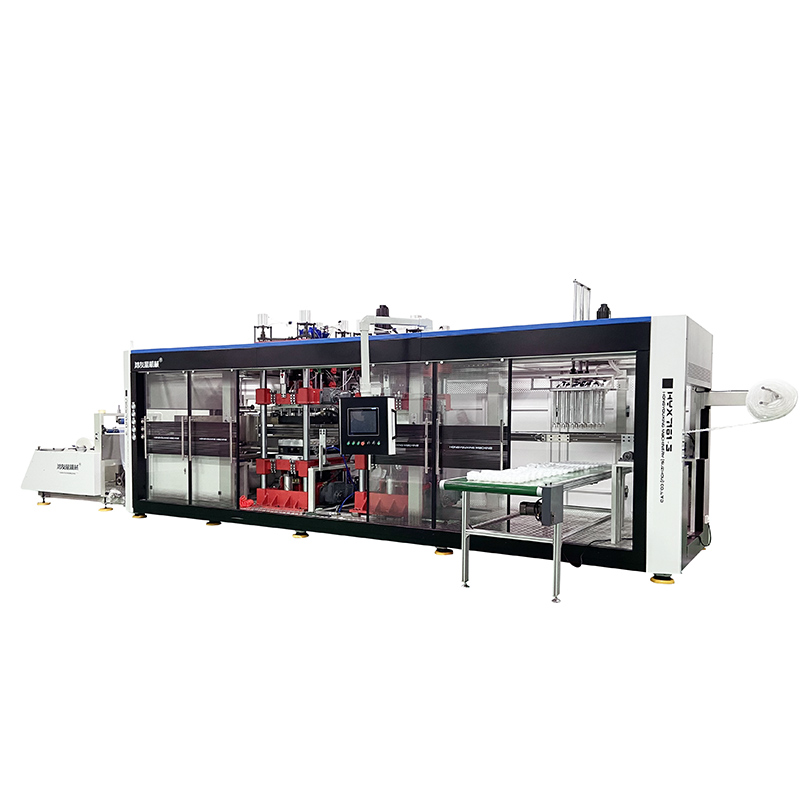 HYX-7161 Fully Automatic Three-Station Thermoforming MachineThis positive and negative pressure thermoforming machine suits thin-gauge packaging such as trays, blisters, and cup lids. Its servo stretching and intelligent temperature control help maintain corner thickness and stable flange dimensions over long runs.View Product →
Uniform cooling is the main defense against warpage. The mold surface temperature should remain stable across the whole cavity, and the part should stay in contact with the mold until it sets below its heat-deflection temperature. Draft angle also matters: too little draft creates ejection marks that deform flanges and sidewalls. For shallow parts, 0.5° may be enough; deep and textured parts usually need 3° to 5°.
In many dimensional failures, the cavity is fine and the trim is wrong. If the cutting station is not registered to the formed geometry, every part is out of tolerance even though the mold is perfect. In-mold trimming, or servo-controlled trimming that uses the same reference points as the mold, avoids this problem. That is why integrated lines hold tolerances better than separate cutting operations.
The best mold and the best sheet will still fail if the machine cannot repeat the same motion and the same heating cycle. Three machine characteristics have a direct influence on dimensional accuracy.
Station layout changes accuracy as well. In a three-station machine, heating, forming, and unloading overlap, which improves output. In a four-station machine, the formed part stays in contact with the mold for an additional cooling station before ejection. The extra dwell time under pressure or vacuum lets the material set more fully, which reduces warpage and stabilizes final dimensions. For industrial parts that feed directly into downstream assembly, the gain in dimensional stability is visible from the first batch.
The mold is the benchmark against which every formed part is measured. If the mold surface is machined outside its tolerance, the error appears in every part. If the mold face temperature varies from one zone to another, cooling and shrinkage vary with it. Aluminum is the standard mold material in thermoforming because it conducts heat quickly and evenly, allowing tight temperature control and shorter cycles.
A precision aluminum mold delivers more than shape. Its cooling channel layout determines how uniformly the part is chilled. Its venting pattern determines whether the sheet fills the last corners completely. Its surface finish sets the texture that later influences stiffness, sealing, and release. For parts such as interior automotive panels and protective packaging, the forming tool and the trim tool must be designed as one system, which is a common requirement in automotive parts vacuum packaging applications.
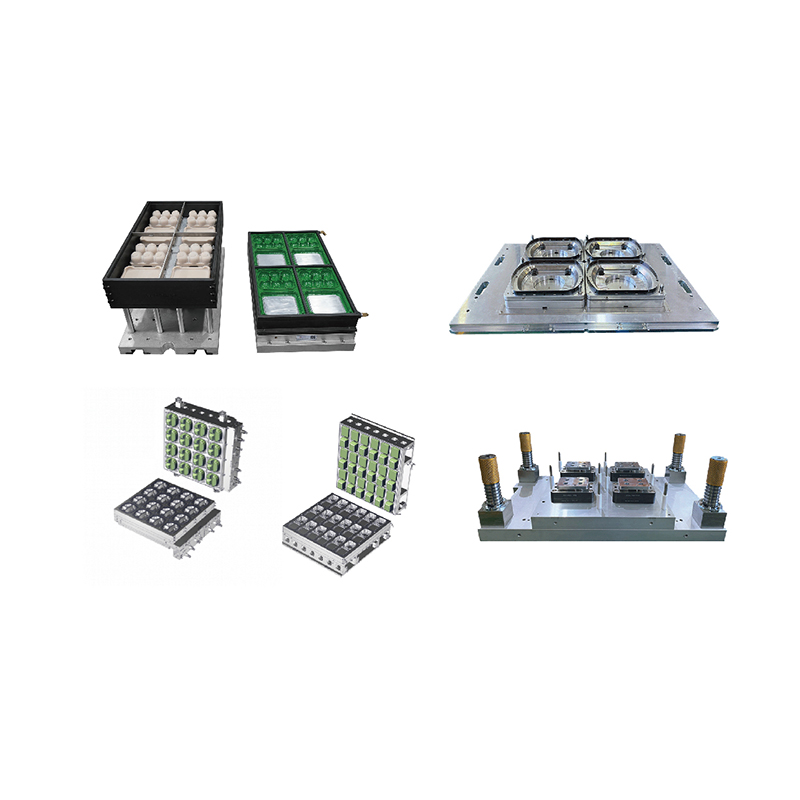
Positive and Negative Pressure Aluminum Thermoforming MoldThis aluminum mold uses coordinated positive and negative pressure with internal cooling and gas channels. It provides precise temperature control and venting, which supports uniform cooling, proper shrinkage compensation, and consistent wall thickness for automotive and packaging parts.View Product →
When you evaluate a mold, do not limit the specification to the forming surface. Ask for documented machining tolerances, cooling channel position checks, and the shrinkage compensation values applied in the tool design. The mold design offsets material shrinkage; if that offset is wrong, final parts will consistently miss the target dimension.
Specifying the right tolerance is a cost decision as much as an engineering decision. A tolerance that is tighter than the process needs forces thicker sheet, longer cycles, more testing, and rejects parts that would actually function. A practical starting point for thermoforming is ±0.5% of the nominal dimension under controlled conditions. The table below shows realistic values for common part categories.
| Part type | Characteristic dimension | Typical tolerance |
|---|---|---|
| Small blisters, inserts, cups | Up to 150 mm | ±0.25–0.50 mm |
| Trays, lids, clamshells | 150–500 mm | ±0.50–1.00 mm |
| Heavy-gauge housings, panels | Over 500 mm | ±1.00–2.00 mm |
| Hole positions, in-mold trimmed | Any size | ±0.10–0.25 mm |
Rule of thumb: a dimension trimmed in the tool holds a tighter tolerance than a dimension cut afterwards. The further the cutting step moves from the forming reference, the more error it adds.
Verification requires a defined condition. Measure after enough time for the part to reach temperature equilibrium, typically 24 hours at 23 °C and 50% relative humidity. Use a coordinate measuring machine for critical dimensions, an optical comparator for thin parts, or a go/no-go gauge for repetitive checks. Never compare parts measured at different temperatures or immediately after demolding.
When buying a machine or a mold, require a first-article report. The report should list measured values, material grade, machine settings, and measurement conditions. A supplier that can document its accuracy upfront saves you weeks of validation work.
For most thin-gauge thermoformed products, a practical tolerance is ±0.5% of the nominal dimension. Small parts under 150 mm can hold ±0.25–0.50 mm, while large heavy-gauge parts usually stay within ±1.00–2.00 mm. Tighter values are possible with pressure forming, in-mold trimming, and tighter process control.
Warpage comes from non-uniform cooling. The part leaves the mold while some areas are still soft and others have already set. Mold temperature stability, the additional cooling dwell time in a four-station machine, and the shrinkage behavior of the material are the main levers.
Yes. Positive air pressure pushes the sheet harder against the tool, which reproduces sharper corners, deeper details, and more uniform wall thickness. Parts formed with vacuum alone are more exposed to sheet sag and thinning, so their dimensions drift more between runs.
A stable mold temperature reduces variation in shrinkage and prevents uneven cooling. For semi-crystalline materials such as PP and PE, mold temperature directly changes crystallinity and post-mold shrinkage, and both appear as measurable differences in final part dimensions.
Dimensional accuracy in thermoformed products comes from a chain of decisions: a material with predictable shrinkage, a sheet with consistent thickness, a mold with controlled temperature, a machine with repeatable motion, and a trim operation registered to the forming geometry. Choose each element deliberately, and the finished part will hold its tolerance run after run.

 +8618621972598
 +8613917961988
 [email protected]
 No. 565, Xinchuan Road, Xinta Community, Lili Town, Wujiang District, Suzhou City, China
Copyright © 2024 Thermoforming Machine/Plastic Cup Machine All Rights Reserved.Custom Automatic Vacuum Thermoforming Plastic Machine Manufacturers