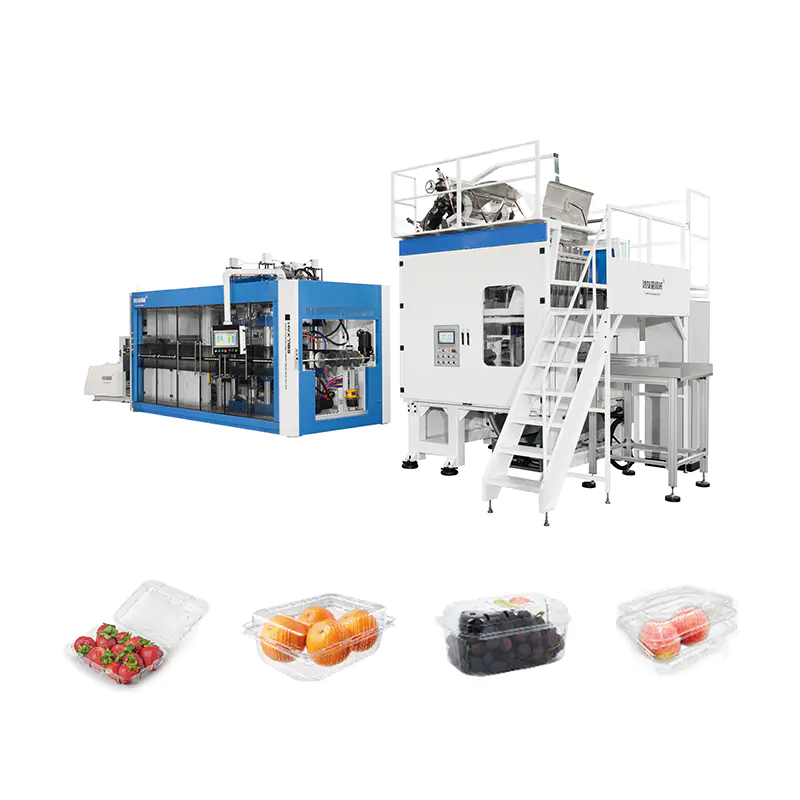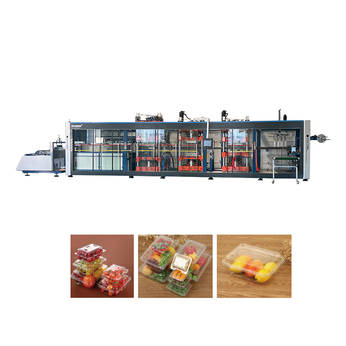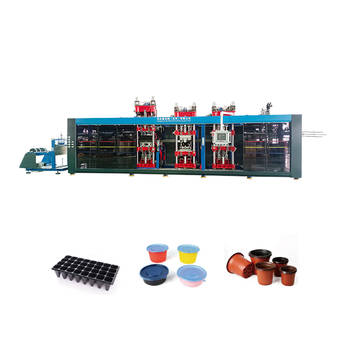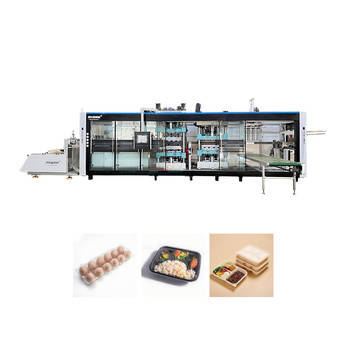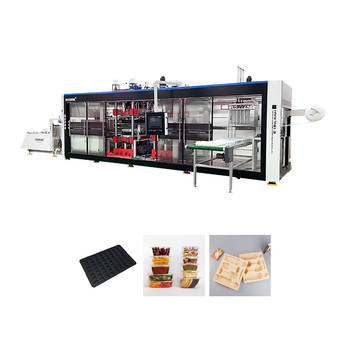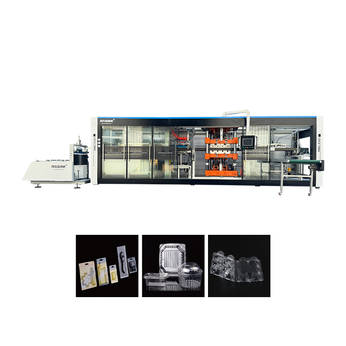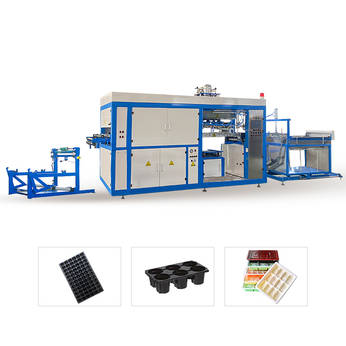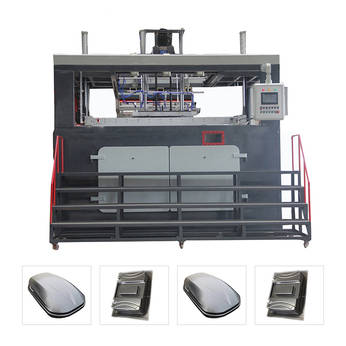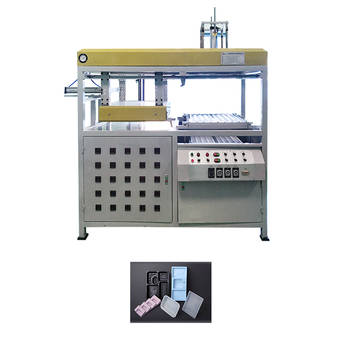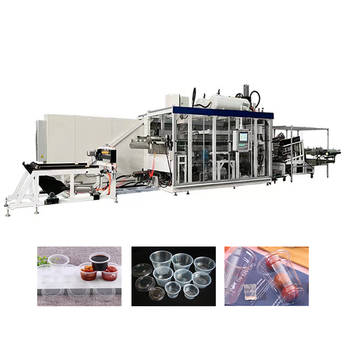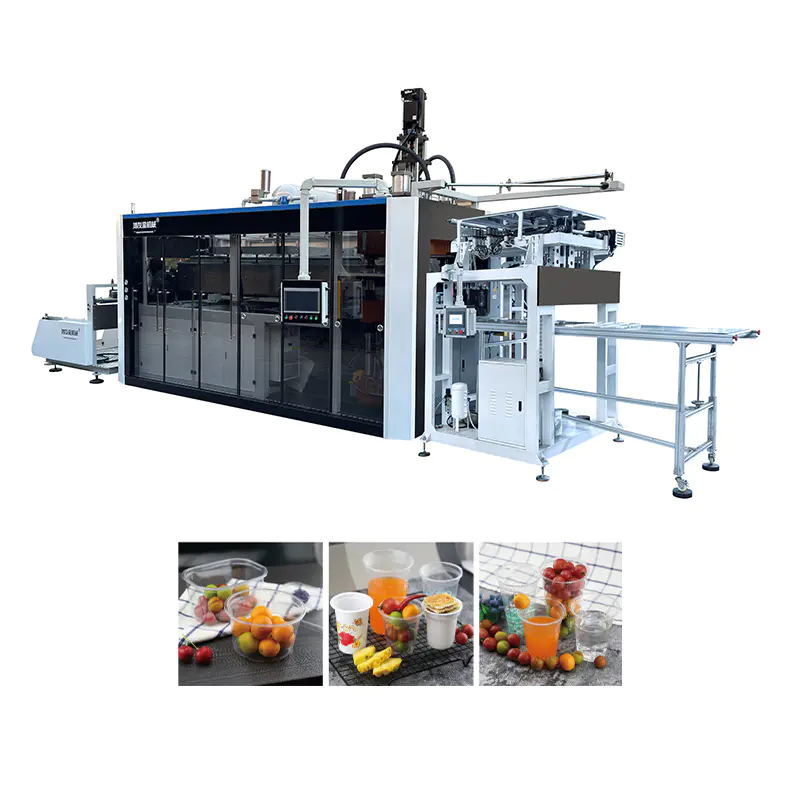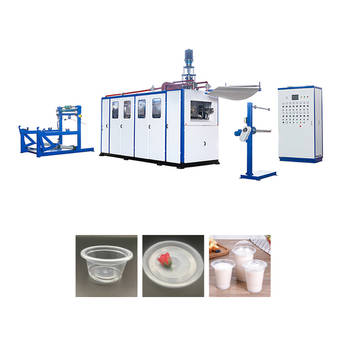
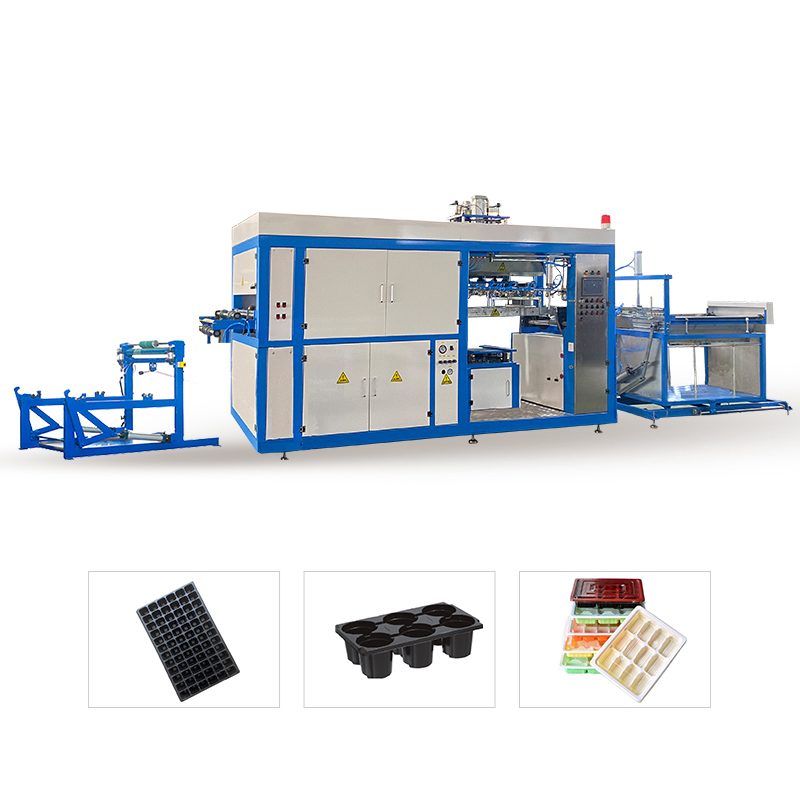
A vacuum forming machine heats a thermoplastic sheet until it becomes soft and pliable, then uses vacuum pressure to draw the material tightly over a mold, shaping it precisely as it cools. The result is a rigid or semi-rigid plastic part that mirrors the mold's geometry. This process is widely used across packaging, automotive, medical, and consumer product industries because it is fast, cost-effective, and capable of producing large parts with relatively low tooling costs.
In simple terms: heat + vacuum + mold = formed plastic part. The machine automates or semi-automates each of these three steps to achieve consistent, repeatable results at scale.
Understanding the core process helps clarify what the machine actually does during each production cycle:
Cycle times typically range from 30 seconds to several minutes, depending on material thickness, part complexity, and machine automation level.
Each component plays a direct role in shaping quality and output speed:
| Component | Function | Impact on Output |
| Clamping Frame | Holds the plastic sheet flat and secure | Prevents warping and uneven forming |
| Heating Element | Uniformly heats the sheet to forming temperature | Even heat = consistent wall thickness |
| Vacuum Pump | Evacuates air between sheet and mold | Determines detail reproduction accuracy |
| Mold/Tool | Defines the final 3D shape of the part | Material can be aluminum, resin, or wood |
| Cooling System | Accelerates part solidification | Shorter cycle times, dimensional stability |
| Control System (PLC) | Coordinates temperature, timing, vacuum | Repeatability and reduced operator error |
Advanced machines integrate PLC touchscreen controls, allowing operators to save process parameters for each product — a major advantage when running multiple SKUs in the same facility.
Machines are broadly categorized by automation level. Choosing the right type depends on production volume, labor availability, and budget:
The operator controls most steps by hand — loading the sheet, positioning the mold, and initiating the vacuum. These machines suit very low-volume prototyping or educational settings, with typical forming areas under 600 mm × 500 mm. Labor intensity is high and cycle-to-cycle consistency is limited.
A semi automatic vacuum forming machine automates the heating, vacuum, and mold movement sequences while still requiring an operator to load sheets and remove finished parts. This balance makes it the most popular choice for small to medium production runs. Key advantages include:
Industries such as food packaging, display manufacturing, and automotive interior component production frequently rely on semi automatic models for their balance of efficiency and flexibility.
These machines handle the entire process — sheet feeding, heating, forming, trimming, and stacking — with minimal human intervention. They are designed for high-volume continuous production, often running at speeds exceeding 20 cycles per minute for thin-gauge packaging applications. The higher capital cost is justified when output volume is consistently large.
The machine works with a broad range of thermoplastics. Material selection affects the forming temperature, mold requirements, and the final product's properties:
Material thickness typically processed ranges from 0.5 mm to 15 mm, with thin-gauge (under 1.5 mm) materials common in packaging and thick-gauge used in industrial and vehicle components.
The versatility of vacuum forming is reflected in how many sectors depend on it:
| Industry | Typical Products |
| Food Packaging | Blister packs, trays, clamshells, lids |
| Automotive | Door panels, dashboards, trunk liners, mudguards |
| Medical & Healthcare | Equipment housings, sterile packaging, prosthetic components |
| Retail & Display | Point-of-sale displays, product stands, signage |
| Electronics | Device enclosures, protective inserts, component trays |
| Agriculture | Seedling trays, irrigation components |
| Construction | Decorative panels, skylights, shower enclosures |
Vacuum forming is particularly valued where large surface area parts with moderate detail are needed — a space where injection molding would require far more expensive tooling.
Comparing vacuum forming with alternative processes highlights where it delivers the most value:
| Process | Tooling Cost | Best For | Typical Lead Time |
| Vacuum Forming | Low – Medium | Large parts, low-to-medium volume | Days to weeks |
| Injection Molding | High | High-volume small precision parts | Weeks to months |
| Blow Molding | Medium | Hollow containers and bottles | Weeks |
| Pressure Forming | Medium | Fine surface detail, similar to vacuum | Days to weeks |
| Rotational Molding | Low – Medium | Large hollow parts | Weeks |
For businesses needing fast prototyping, short production runs, or large-format plastic parts, vacuum forming consistently offers the lowest cost-per-part entry point.
Selecting the right machine depends on several practical factors:
The machine's forming area must accommodate your largest intended product. Common semi automatic machine forming areas range from 600 mm × 500 mm up to 1500 mm × 1000 mm. Oversizing slightly leaves room for future product expansion.
Ceramic or quartz heaters with independently controlled heating zones allow precise temperature tuning across the sheet. This is critical for materials with narrow forming windows or for parts with varying thickness requirements.
Pump capacity, measured in m³/h, determines how quickly and completely the air is evacuated. Insufficient vacuum leads to incomplete forming, especially in deep-draw applications where depth-to-width ratios exceed 1:1.
A PLC-based touchscreen controller that allows operators to save and recall product-specific parameters significantly reduces setup time when switching jobs — a key efficiency factor for facilities running 10 or more different product types.
Verify the machine's rated maximum sheet thickness. Attempting to form material beyond the rated capacity results in incomplete forming and potential heater damage. Most semi automatic models handle up to 8 mm or 10 mm for standard applications.
It shapes heated thermoplastic sheets into three-dimensional parts by pressing them against a mold using vacuum pressure. The machine is used to produce plastic products for packaging, automotive, medical, and many other industries.
It is best suited for small to medium production volumes where consistent quality is needed but a fully automated line is not yet justified by volume. It offers faster cycle times than manual machines at a lower cost than full automation.
Common materials include ABS, HIPS, PET, PETG, PP, PC, and HDPE. The correct forming temperature varies by material and should match the machine's heater range.
Most semi automatic machines process sheets from 0.5 mm to 8–10 mm. Heavy-gauge industrial machines can handle thicker materials up to 15 mm.
Cycle times depend on material, thickness, and machine type. Typical cycles on a semi automatic machine range from 60 seconds to 5 minutes per part.
Vacuum forming uses atmospheric pressure (~101 kPa) to push the sheet against the mold. Pressure forming adds positive air pressure on top, achieving finer surface detail and sharper edges, but at higher tooling and equipment cost.
Yes. Molds can be made from wood, resin, or aluminum at relatively low cost, making vacuum forming one of the most accessible methods for functional plastic prototypes.

 +8618621972598
  +8613917961988
  [email protected]
 No. 565, Xinchuan Road, Xinta Community, Lili Town, Wujiang District, Suzhou City, China
 Copyright © 2024 Thermoforming Machine/Plastic Cup Machine All Rights Reserved.Custom Automatic Vacuum Thermoforming Plastic Machine Manufacturers



 English
 عربى
عربى 简体中文
简体中文