

 English
 عربى
عربى 简体中文
简体中文
Home / News / Industry News / What are the labor requirements for operating a semi-automatic vacuum forming machine?

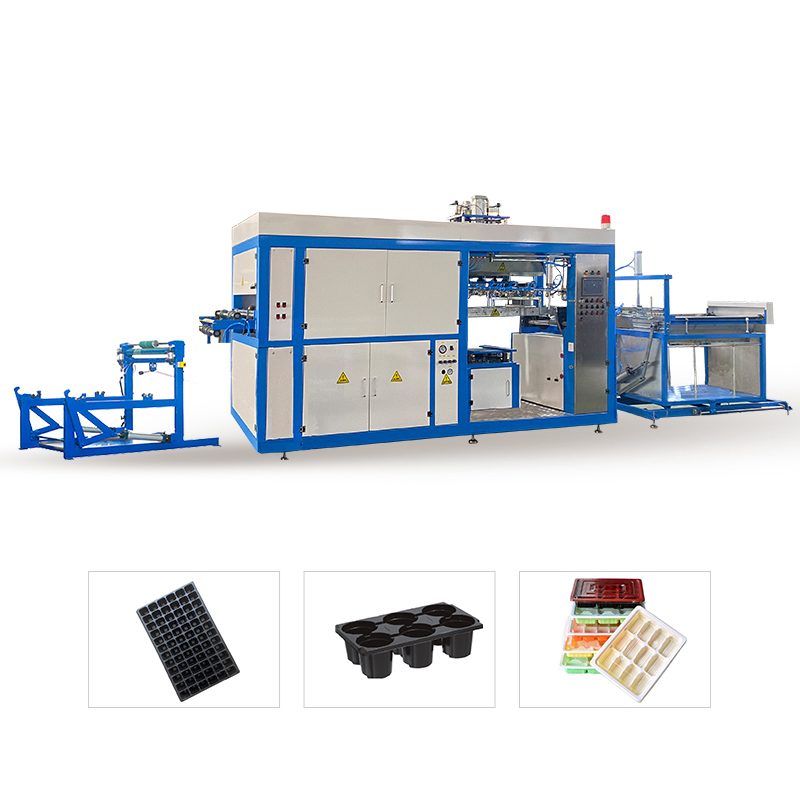
The operation of a Semi Automatic Vacuum Forming Machine requires professional, qualified personnel to ensure stable production, product quality, and workplace safety. All operators must meet basic qualification standards before taking up their posts, which form the foundation of efficient machine operation.
Operators should hold at least a junior high school diploma or equivalent vocational education certificate. This educational baseline ensures they can understand machine manuals, operation guidelines, and safety protocols written in standard technical language.
Physical fitness is a critical requirement. Operators must have normal eyesight, including corrected vision, to monitor material feeding, forming processes, and product quality in real time. They need intact hand-eye coordination to handle control panels, material adjustments, and emergency operations accurately.
Personnel must be in good physical health with no chronic diseases, vertigo, or hearing impairments that could affect their ability to respond to machine signals and emergency situations. The working environment involves moderate noise and continuous standing, so physical endurance is necessary for sustained daily operation.
Entry-level operators without prior experience must complete a minimum of 30 hours of systematic on-the-job training, including theoretical learning and practical operation. Experienced personnel with more than 6 months of semi-automatic thermoforming equipment operation experience can be assigned to independent posts after a 10-hour adaptation training specific to the machine model.
All operators must master core skills including equipment parameter setting, plastic sheet loading and positioning, vacuum forming process monitoring, preliminary product quality inspection, and routine machine maintenance. These skills directly determine production efficiency and finished product qualification rate.
Qualified operators can identify common forming defects such as insufficient forming, material wrinkling, and overheating damage, and make independent adjustments to parameters like heating temperature, holding time, and vacuum pressure to resolve minor issues within 5 minutes.
Formal pre-job training and certification are mandatory for all personnel operating a Semi Automatic Vacuum Forming Machine. Untrained operators are prohibited from independent operation to avoid equipment damage, production accidents, and quality non-compliance.
Theoretical training covers four core modules, each requiring a passing score of 85 or higher in the assessment. The modules include machine structure and working principle, safety operation specifications, parameter setting standards, and daily maintenance knowledge.
Practical training accounts for 70% of the total training duration, focusing on hands-on operation proficiency. Trainees practice under the guidance of certified instructors until they can complete the entire production process independently.
After completing training, personnel must pass a unified assessment including theoretical written examination and practical operation evaluation. Those who pass both parts receive an official operation certification and are allowed to work independently.
Certification is valid for 2 years. Operators must participate in retraining and reassessment before expiration to update their knowledge of upgraded functions, new materials, and optimized operation methods. Expired certifications without renewal will result in suspension of independent operation rights.
Operators of a Semi Automatic Vacuum Forming Machine undertake clear daily responsibilities covering pre-production preparation, in-production monitoring, post-production finishing, and teamwork coordination. Each duty directly affects the overall production efficiency.
Before starting the machine, operators complete a full set of inspection tasks within 15 minutes to ensure the equipment is in optimal working condition. This step reduces downtime caused by equipment abnormalities during production.
Check the power supply, air compressor, and vacuum pump to confirm stable operation and no air leakage or circuit faults. Verify the cleanliness of the working area, removing debris and flammable materials near the heating system to eliminate safety hazards.
Prepare raw materials according to production orders, including selecting the correct plastic sheet type, thickness, and size. Conduct a preliminary inspection of materials to avoid using damaged or unqualified sheets that cause forming failures.
Set machine parameters based on product requirements and material characteristics, including heating zone temperature, heating duration, vacuum suction time, and cooling time. Record parameter settings in the production log for traceability.
During continuous operation, operators remain at their posts and monitor the machine status in real time. They are not allowed to leave the equipment without permission or perform unrelated operations during working hours.
Conduct sampling inspection on finished products every 10 pieces, checking dimensions, surface smoothness, forming completeness, and defects. Adjust parameters immediately if non-conforming products are found to reduce scrap rate to below 3%.
Record key production data including total output, qualified product quantity, abnormal situations, and parameter adjustments. Timely report equipment failures or unresolved quality issues to maintenance personnel and supervisors to avoid prolonged downtime.
Follow safety protocols strictly during operation, including using protective equipment, avoiding direct contact with heating components, and operating control buttons according to standard procedures to prevent personal injury.
After completing production tasks, shut down the machine following the correct sequence: stop heating system → turn off vacuum pump → cut off power → close air supply. Never cut off power directly to avoid equipment damage.
Clean the workbench, forming mold, and heating components, removing plastic residues and dust. Use designated cleaning tools to avoid scratching mold surfaces or damaging electrical parts.
Sort and count finished products, separate qualified and defective items, and attach production labels. Organize production logs and submit them to the management team as required.
Perform routine maintenance including lubricating movable parts, checking pipeline connections, and covering the machine with a dust cover if it will be idle for a long time.
Safety is the top priority in operating a Semi Automatic Vacuum Forming Machine. All personnel must comply with strict safety requirements to protect personal safety, extend equipment service life, and ensure stable production.
Operators must wear standard personal protective equipment during the entire working period. Non-compliance with PPE usage is a serious violation of operation rules.
Operators must not modify the machine's safety protection devices, including emergency stop buttons, safety interlocks, and temperature overload protectors. Any damage to safety components requires immediate reporting and shutdown for maintenance.
The emergency stop button can only be used in critical situations such as equipment malfunction, material jamming, or personal safety risks. After using the emergency stop, conduct a full equipment inspection before restarting.
Do not place hands, tools, or foreign objects near the mold area during the heating and forming process. Wait for the system to stop completely and cool down before performing mold replacement or cleaning.
Regularly check for overheating, abnormal noise, or air leakage during operation. If any abnormality is detected, shut down the machine immediately and notify maintenance personnel instead of continuing operation.
The operating area must maintain good ventilation and lighting conditions, with illumination intensity not less than 300 lux to ensure clear observation of the forming process.
Flammable and explosive materials are strictly prohibited within 1 meter of the machine. Fire extinguishers must be equipped in the working area and checked monthly for availability.
Keep the workplace tidy, with raw materials, finished products, and tools placed in designated areas. Do not stack items randomly to avoid blocking emergency passages.
Operators share responsibility for daily maintenance and inspection of the Semi Automatic Vacuum Forming Machine. Professional maintenance personnel handle major overhauls, while operators complete routine checks to keep the equipment in good condition.
Daily maintenance is a core responsibility, taking 20-30 minutes after each production shift. Consistent maintenance extends the machine's service life by 3-5 years and reduces failure rates significantly.
Clean the heating elements, vacuum nozzles, and mold surfaces to remove plastic residue. Wipe the control panel and frame with a dry cloth to keep the equipment clean.
Check air pipelines and electrical connections for looseness, air leakage, or damage. Tighten loose connectors and report any serious issues immediately.
Lubricate sliding components such as guide rails and hinges with designated lubricants to reduce friction and ensure smooth movement.
Check the condition of the clamping system and conveyor belt, adjusting tension if necessary to ensure stable material feeding and positioning.
Weekly inspections focus on key system performance, including vacuum pressure stability, heating temperature uniformity, and cooling system efficiency. Record inspection results in the equipment maintenance log.
Monthly inspections include calibration of temperature sensors and vacuum gauges to ensure parameter accuracy. Check the wear condition of vulnerable parts such as heating pipes and sealing strips, and arrange replacements in advance.
Operators must cooperate with professional maintenance personnel during quarterly and annual overhauls, providing detailed operation records and assisting in equipment disassembly, inspection, and reassembly.
All maintenance and inspection activities must be recorded completely and accurately. Records include maintenance date, tasks performed, abnormal conditions, replacement parts, and operator signature.
Maintenance logs serve as important references for equipment performance evaluation and fault tracing. They must be stored for at least 1 year for management review and audit purposes.
Reasonable labor allocation and efficient teamwork are essential for maximizing the production capacity of a Semi Automatic Vacuum Forming Machine. The number of operators and division of labor are configured based on production scale and product complexity.
For a single Semi Automatic Vacuum Forming Machine, the standard labor allocation is 1 primary operator and 1 assistant operator for medium and large-scale production lines. For small-batch production, 1 independent operator is sufficient to complete all tasks.
Primary operators are responsible for parameter setting, quality control, and equipment operation. Assistant operators handle material preparation, product handling, and workplace cleaning, improving overall production efficiency.
When operating multiple machines simultaneously, one skilled operator can manage 2 semi-automatic units with assistant support, provided that product complexity is low and production processes are stable.
Operators must maintain effective communication with team members, including production supervisors, quality inspectors, and maintenance personnel, to ensure coordinated workflow.
Report production progress and quality issues to supervisors in a timely manner. Communicate with quality inspectors to clarify product standards and resolve quality deviations quickly.
During shift handover, convey complete information including equipment status, remaining production tasks, parameter settings, and unresolved issues to ensure continuous and stable production.
Enterprises recommend conducting cross-training for operators to master multiple posts including operation, auxiliary handling, and basic quality inspection. This improves workforce flexibility and应对人员短缺的能力.
Skilled operators with multi-post competence can take on leadership roles in small teams, guiding new personnel and coordinating daily production, enhancing the overall capability of the production team.
To maintain high-quality operation of the Semi Automatic Vacuum Forming Machine, operators need continuous skill improvement and regular performance evaluation to adapt to evolving production demands.
Performance evaluation is conducted monthly, focusing on key indicators that reflect operation quality and work attitude. The evaluation results determine post adjustment and training arrangements.
| Evaluation Indicator | Standard Requirement | Weight Ratio |
| Product Qualification Rate | ≥97% | 35% |
| Production Efficiency | Meet scheduled output | 25% |
| Safety Compliance | No violations or accidents | 20% |
| Equipment Maintenance | Complete tasks on time | 15% |
| Work Attitude | Responsible and cooperative | 5% |
Operators participate in at least 1 skill upgrade training per year, covering new material forming technologies, advanced parameter optimization methods, and upgraded machine functions.
Internal skill competitions and experience sharing sessions are organized regularly to allow operators to learn efficient operation skills from each other and improve the overall technical level of the team.
Personnel with excellent performance and skills can obtain promotion opportunities to become team leaders, trainers, or quality supervisors, providing clear career development paths.
A: Operators must be at least 18 years old and have full capacity for civil conduct.
A: No, only personnel who have completed training and obtained certification can operate independently.
A: Recertification is required every 2 years to update skills and knowledge.
A: Operators complete daily maintenance; professional staff handle major overhauls.
A: Heat-resistant gloves, safety goggles, insulated work shoes, and standard work uniforms.
A: 1 operator for small production; 1 operator + 1 assistant for large-scale production.
A: The scrap rate should be controlled below 3% under normal production conditions.
A: No, safety devices cannot be modified without approval from maintenance personnel.
A: Yes, good health and normal sensory functions are essential for safe operation.
A: New personnel need at least 30 hours of training before independent operation.

 +8618621972598
  +8613917961988
  [email protected]
 No. 565, Xinchuan Road, Xinta Community, Lili Town, Wujiang District, Suzhou City, China
 Copyright © 2024 Thermoforming Machine/Plastic Cup Machine All Rights Reserved.Custom Automatic Vacuum Thermoforming Plastic Machine Manufacturers