

 English
 عربى
عربى 简体中文
简体中文
Home / News / Industry News / 3-Station vs 4-Station Thermoforming Machine: Key Differences Explained

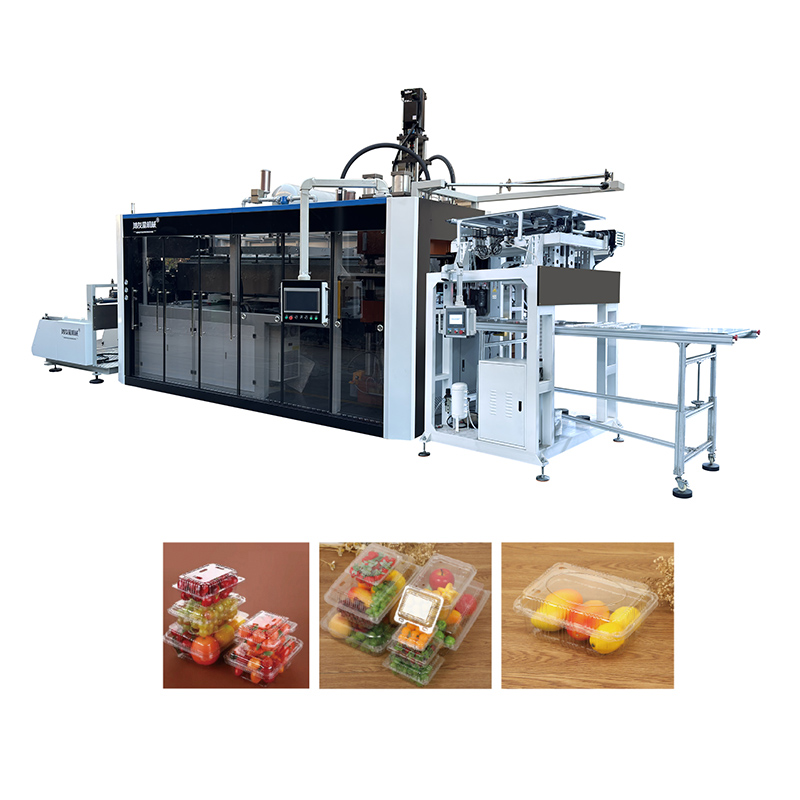
Thermoforming machines are essential equipment in the plastic packaging industry, transforming flat plastic sheets into various containers, trays, and packaging products through heat and pressure. The number of stations in a thermoforming machine directly impacts production efficiency, product quality, and operational complexity. Understanding the fundamental differences between 3-station and 4-station configurations helps manufacturers make informed decisions when selecting equipment for their specific production requirements.
A station in thermoforming terminology refers to a distinct operational zone where specific processing steps occur. These stations work in a continuous cycle, with the plastic sheet moving sequentially through each station to complete the transformation from raw material to finished product. The station count determines how many simultaneous operations can occur and how the workflow is distributed across the production line.
Three-station thermoforming machines consolidate the essential production processes into three primary operational zones. These machines typically integrate forming, cutting, and stacking functions within a compact footprint, making them suitable for manufacturers with space constraints or moderate production volume requirements.
The three stations in this configuration are organized as follows:
Three-station machines offer several practical benefits for specific manufacturing scenarios:
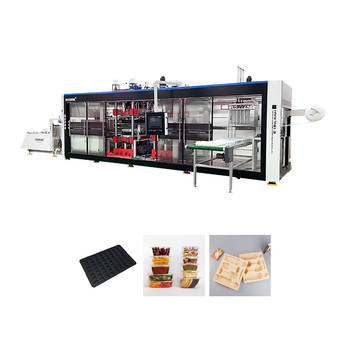
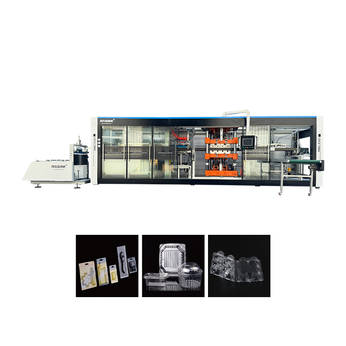
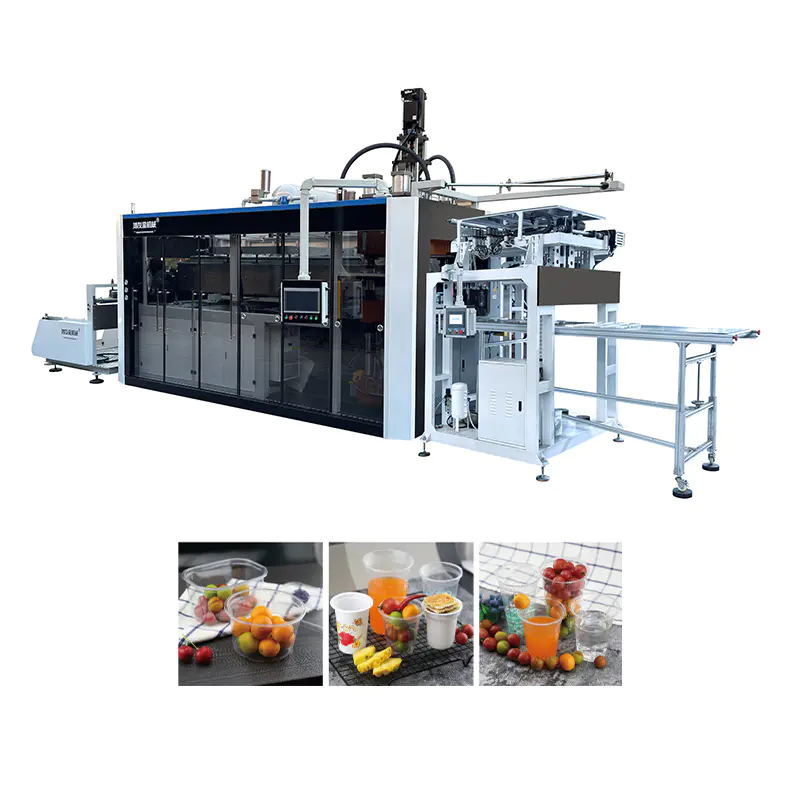
Full-Automatic 4 Stations Thermoforming Machine systems represent the advanced tier of thermoforming technology, separating heating, forming, cutting, and stacking into distinct dedicated stations. This separation allows for optimized process control and higher production speeds.
The four dedicated stations provide specialized processing environments:
Four-station machines deliver superior performance for high-volume production environments:
When evaluating 3-station versus 4-station thermoforming machines, several performance metrics demonstrate the practical differences between these configurations:
| Performance Metric | 3-Station Machine | 4-Station Machine |
| Typical Output Rate | 15-25 cycles/min | 25-35 cycles/min |
| Floor Space Requirement | Compact (8-12m length) | Extended (12-18m length) |
| Material Thickness Range | 0.2-2.0mm | 0.15-3.0mm |
| Product Complexity | Standard to moderate | Simple to complex |
| Changeover Time | 30-60 minutes | 45-90 minutes |
| Energy Consumption | Lower per unit | Higher total, efficient per piece |
| Initial Investment | Moderate | Premium |
Selecting between 3-station and 4-station configurations depends primarily on production volume requirements, product specifications, and operational priorities. Different industries and applications favor specific machine types based on their unique demands.
Three-station thermoforming machines excel in the following scenarios:
Four-station configurations are optimal for demanding production environments:
Beyond production specifications, operational factors significantly influence the total cost of ownership and long-term satisfaction with thermoforming equipment. Understanding maintenance profiles and operational demands helps manufacturers prepare appropriate resource allocation.
Three-station machines feature consolidated mechanical systems, reducing the number of components requiring regular service. Maintenance intervals typically occur every 2,000-3,000 operating hours for major servicing, with daily cleaning and inspection protocols requiring approximately 30-45 minutes. The integrated station design means that heating element replacement and forming die maintenance can often occur simultaneously.
Four-station machines, with their modular design, allow for station-specific maintenance without complete production line shutdown. Individual stations can be serviced while others remain operational, reducing total downtime impact. However, the increased component count means maintenance schedules are more complex, typically requiring specialized technicians and comprehensive spare parts inventory. Major maintenance cycles occur every 3,000-4,000 hours, but the distributed workload often results in more predictable maintenance costs.
Three-station systems generally require less specialized training due to their consolidated control interfaces and simplified troubleshooting procedures. Operators can typically achieve proficiency within 2-4 weeks of supervised training, with single-point adjustments affecting multiple process parameters simultaneously.
Four-station machines demand more comprehensive training programs, often extending to 6-8 weeks before operators can independently manage all station parameters. The independent control systems for each station require understanding of inter-station relationships and timing synchronization. However, this complexity enables fine-tuning capabilities that experienced operators leverage for product quality optimization and material efficiency improvements.
Both 3-station and 4-station thermoforming machines accommodate common thermoplastic materials including PET, PP, PS, PVC, and PLA. However, processing characteristics vary between configurations based on thermal management capabilities and forming precision.
Three-station machines process standard material thicknesses from 0.2mm to 2.0mm effectively, handling the majority of food packaging, consumer goods, and industrial applications. The combined heating and forming station works efficiently with materials having broad processing windows and forgiving thermal characteristics.
Four-station machines extend material capabilities to 0.15mm ultra-thin films and up to 3.0mm heavy-gauge sheets. The dedicated preheating station enables processing of temperature-sensitive materials like PLA and specialized barrier films that require gradual thermal conditioning. Advanced forming stations accommodate complex geometries, deep draws exceeding 100mm depth, and precision medical-grade products requiring exact dimensional control.
The product range capabilities differ significantly between configurations:
Financial evaluation of thermoforming equipment extends beyond initial purchase price to encompass operational costs, productivity gains, and product quality improvements. A comprehensive ROI analysis considers all cost factors over the equipment lifecycle.
Initial capital investment for 4-station machines typically runs 30-50% higher than equivalent 3-station models. However, this premium is offset by several operational advantages:
For manufacturers producing over 8 million units annually, the payback period for the additional investment in 4-station equipment typically ranges from 18 to 30 months. Lower volume operations may find that 3-station machines provide better ROI, with payback periods extending beyond 36 months for premium 4-station configurations that remain underutilized.
The primary difference lies in station specialization. Three-station machines combine heating and forming functions, resulting in a more compact design with moderate speeds. Four-station machines separate these processes into dedicated stations, enabling higher production speeds up to 35 cycles per minute and superior product quality through precise temperature control.
Start-up operations typically benefit from 3-station machines due to lower capital investment, reduced space requirements, and simpler operation. As production volumes grow beyond 5 million units annually, upgrading to a 4-station system becomes economically advantageous.
Three-station machines handle standard packaging products effectively, including trays, cups, and clamshells. However, complex deep-draw products, ultra-thin wall containers, and precision medical packaging typically require the dedicated processing stations and precise control offered by 4-station systems.
Four-station machines typically achieve production speeds 25-40% faster than 3-station equivalents, with output rates ranging from 25-35 cycles per minute compared to 15-25 cycles per minute for 3-station configurations.
Three-station machines feature simpler maintenance requirements with fewer components and consolidated service points. Four-station machines have more complex maintenance schedules but offer modular service advantages where individual stations can be maintained without complete production shutdown.
The investment premium for 4-station equipment is justified for high-volume operations exceeding 8 million units annually, quality-critical applications like medical packaging, or thin-wall products requiring precise process control. Lower volume operations typically achieve better ROI with 3-station configurations.
Both machines process common thermoplastics including PET, PP, PS, and PVC. Three-station machines excel with standard thickness materials from 0.2-2.0mm. Four-station machines extend capabilities to ultra-thin 0.15mm films and heavy-gauge 3.0mm sheets, plus temperature-sensitive materials like PLA that benefit from dedicated preheating.
Mold changeover on 3-station machines typically requires 30-60 minutes due to simpler mechanical structures. Four-station machines require 45-90 minutes because of the additional stations and synchronization requirements, though some advanced models feature quick-change systems that reduce this time significantly.

 +8618621972598
  +8613917961988
  [email protected]
 No. 565, Xinchuan Road, Xinta Community, Lili Town, Wujiang District, Suzhou City, China
 Copyright © 2024 Thermoforming Machine/Plastic Cup Machine All Rights Reserved.Custom Automatic Vacuum Thermoforming Plastic Machine Manufacturers