

 English
 عربى
عربى 简体中文
简体中文
Home / News / Industry News / How to Optimize High-Output Production for Rigid Plastic Cups and Containers

In the competitive landscape of rigid plastic packaging, achieving high-output production without compromising quality is the defining challenge for modern manufacturers. For producers of plastic cups, containers, and similar thin-walled articles, the interplay between machine design, tooling precision, and process control determines both profitability and market position. This article delivers a technical roadmap for optimizing production lines, with a sharp focus on the plastic cup making machine, the thermoforming mould, and the advanced methodologies that drive throughput upward while holding scrap rates down.
Every high-output line begins with the right equipment. The selection of a plastic cup making machine directly influences cycle time, energy consumption, and product consistency. Modern machines for rigid cup production operate at speeds exceeding 40 cycles per minute, with forming areas that accommodate large sheet widths. However, raw speed alone does not define high output. The machine must integrate seamlessly with upstream sheet feeding, downstream trimming, and stacking systems.
Equally critical is the thermoforming mould, which transfers the machine's motion into precise part geometry. For high-output applications, moulds must deliver rapid heat transfer, uniform wall thickness, and consistent release characteristics. A mismatched mould and machine combination can reduce output by 30% or more, regardless of the machine's rated speed.
Machine Speed
40+ cycles/min with forming area up to 1200 x 800 mm
Mould Cooling
Integrated water channels reduce cycle time by 15-25%
Output Rate
1000-2500 cups/hour per cavity (depending on depth and material)
thin gauge thermoforming is the primary process for manufacturing rigid plastic cups and containers from sheet thicknesses between 0.15 mm and 1.2 mm. This technology relies on heating a thermoplastic sheet to its forming temperature, then shaping it against a mould using vacuum, pressure, or mechanical force. For high-output production, the thin gauge thermoformer must maintain precise temperature control across the entire sheet width, as thermal gradients directly translate to wall thickness variations and rejects.
In a well-tuned thermoforming plastic operation, the heating station consumes 40-60% of the machine's total energy. Optimizing this stage involves matching heater profiles to the sheet's thermal properties. For polypropylene (PP) and polyethylene terephthalate (PET) — the two dominant materials for rigid cups — the optimal forming temperature ranges are 150-170°C and 100-120°C, respectively. Deviations of even 5°C can increase cycle times by 8-12% due to inadequate sag control or premature cooling.
Industry data indicates that converting from a single-zone to a multi-zone heating system in a thin gauge thermoformer reduces edge-to-center temperature variation from 8-12°C down to 2-4°C, directly improving cup wall uniformity by 30-40% and reducing scrap rates by up to 18%.
The forming station itself must deliver rapid, uniform air evacuation. High-output lines typically employ a combination of vacuum and pressure forming, with pressure assistance providing the extra force needed for sharp corners and deep draw ratios. For a 200 ml cup with a draw ratio of 1.5:1, a pressure of 3-5 bar is typical. Optimizing the pressure profile — applying full pressure only after the sheet has contacted the mould — reduces web thinning at the cup's base by 20-25%.
The most direct path to higher output is increasing the number of cavities per mould. Multi-cavity cup moulds have evolved from 4-cavity designs for large containers to 16- or even 24-cavity configurations for standard 200-500 ml cups. However, adding cavities introduces complexity. Each additional cavity increases the forming area, requiring a corresponding adjustment in heating power, vacuum capacity, and mechanical forces. A 16-cavity mould operating at 35 cycles per minute can produce 33,600 cups per hour — a 4x improvement over a 4-cavity mould at the same cycle speed.
But multi-cavity moulds demand precision in three areas:
The table shows that while cavity count increases output, cycle speed typically decreases due to higher thermal loads and mechanical inertia. The optimal balance for most rigid cup production lies between 8 and 16 cavities, where the scrap rate remains manageable and the output per square meter of floor space is maximized.
For cups with a draw ratio exceeding 1.2:1, standard vacuum forming often produces unacceptable wall thinning at the cup corners and base. Plug-assist thermoforming solves this problem by using a heated plug to pre-stretch the sheet before vacuum or pressure is applied. This technique distributes material more evenly across the cup wall, allowing deeper draws with thinner starting sheets.
In a typical plug-assist cycle for a 300 ml cup with a 2:1 draw ratio, the plug advances at a controlled speed of 300-500 mm/s, stretching the sheet to 60-70% of its final depth. The plug's temperature is maintained at 80-120°C for PP and 70-90°C for PET. After the pre-stretch, vacuum and pressure complete the forming. This two-stage process reduces corner thinning from 35-40% (vacuum-only) to 12-18% (plug-assist), enabling the use of 0.30 mm sheet where 0.45 mm would otherwise be required.
Optimizing plug-assist requires careful matching of plug geometry to the cup shape. A hemispherical plug works well for round cups, while a rectangular plug with radiused corners is needed for oval or rectangular containers. The thermoforming mould must include precise guidance for the plug, typically using a four-post alignment system that maintains ±0.05 mm tolerance. Misalignment of just 0.2 mm can cause asymmetric wall thickness and rejects.
Practical benefit: A converter switching from vacuum-only to plug-assist thermoforming plastic for 16-oz coffee cups reduced material consumption by 18% while improving top-load strength by 22%. The payback period for the plug-assist system was under six months.
Conventional thermoforming separates forming and trimming into two distinct steps: the formed sheet exits the machine and is sent to a separate trim press. This approach adds handling time, increases work-in-progress inventory, and introduces alignment errors. Trim-in-place technology integrates trimming into the forming station itself, eliminating the secondary operation.
In a trim-in-place system, the plastic cup making machine includes a die-cutting station that operates within the same cycle as forming. After the cups are formed and cooled, the sheet advances to a trimming die that punches out each cup with precision. The trim-in-place approach delivers three major benefits for high-output production:
For PP/PET sheet thermoforming, trim-in-place technology requires a steel rule die or a solid tool steel die mounted directly on the machine's platens. The die must be designed to handle the specific material's shrinkage characteristics — PP shrinks 1.5-2.5% after forming, while PET shrinks 0.5-1.0%. Modern systems use servo-driven die adjustment to compensate for shrinkage in real time, maintaining trim accuracy within 0.15 mm.
Data from high-volume cup lines shows that adopting trim-in-place reduces overall scrap by 8-12% because there is no secondary handling damage and no registration errors between forming and trimming. For a line producing 50 million cups annually, this represents a reduction of 4-6 million cups of scrap, translating to significant material savings.
The choice between polypropylene (PP) and polyethylene terephthalate (PET) for rigid cups and containers depends on application requirements — PP offers better chemical resistance and higher heat tolerance, while PET provides superior clarity and barrier properties. Optimizing PP/PET sheet thermoforming for high output requires distinct strategies for each material.
PP is semi-crystalline, meaning it has a sharp melting point and a narrow forming window. The optimal forming temperature is 150-165°C, with a tolerance of only ±4°C. Below this range, the sheet is too stiff to form; above it, the sheet sags excessively and may stick to the mould. For high-output PP production, a thin gauge thermoformer must have rapid-response heaters that can maintain setpoint temperature within ±2°C across the sheet width. Additionally, PP has a high coefficient of thermal expansion — 150-200 μm/m·°C — so moulds must incorporate expansion allowances. A 600 mm wide PP sheet will expand by 1.2-1.6 mm during heating, requiring mould clamping forces of 200-300 kN to prevent leakage.
PET is amorphous (or semi-crystalline depending on grade) and has a wider forming window of 100-130°C. However, PET is prone to crystallization if held at elevated temperatures for too long, leading to cloudiness and brittleness. High-output PET production requires precise dwell time control. Typical heating times for 0.30 mm PET sheet are 3-5 seconds, with cooling times of 4-6 seconds. The key to high output in PET is the use of a thermoforming mould with active cooling channels that can drop the part temperature below 60°C within 3 seconds, allowing immediate demolding.
Material comparison for high-output cup production:
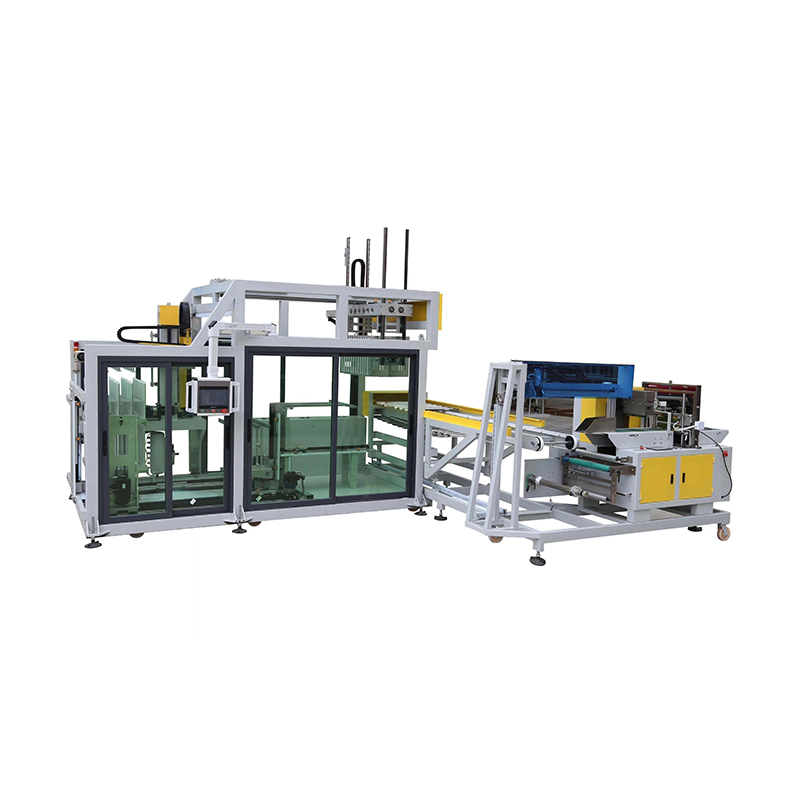
Even the fastest plastic cup making machine cannot deliver high output if the downstream stacking system cannot keep pace. High-speed stacking systems are the unsung heroes of thermoforming lines, responsible for collecting cups from the trim station, nesting them in stacks, and transferring them to packaging. A stacking system that operates at 40 cups per minute per lane is adequate for a 4-cavity mould, but a 16-cavity mould at 32 cycles per minute produces 512 cups per minute — requiring a stacking system capable of 8-10 lanes operating at 50-65 cups per minute each.
Modern high-speed stacking systems use servo-driven conveyors, vacuum grippers, and optical sensors to track each cup's position. Key optimization parameters include:
Integrating the stacking system with the plastic cup making machine's PLC allows real-time speed matching. If the stacking system detects a jam or a full lane, it signals the machine to slow down or pause, preventing cup spillage and damage. Data from high-output lines shows that a well-integrated stacking system improves overall equipment effectiveness (OEE) by 12-18% compared to a standalone, manually monitored system.
Example: A 12-cavity line producing 250 ml cups at 30 cycles/min generates 360 cups/min. A 6-lane high-speed stacking system running at 60 cups/min per lane provides a 10% capacity buffer, allowing for brief stoppages in any lane without affecting overall line output.
Optimizing high-output production for rigid plastic cups and containers is not a matter of tuning a single parameter but rather synchronizing the entire production chain. The plastic cup making machine, the thermoforming mould, and the auxiliary systems must work as a single, coordinated unit. A practical approach to integrated optimization follows these steps:
Following this methodology, a typical cup manufacturer can increase output by 20-35% over a 6-month period, with scrap rates dropping from 6-8% to 2-4%. The key is to treat the production line as a system, not a collection of independent machines.
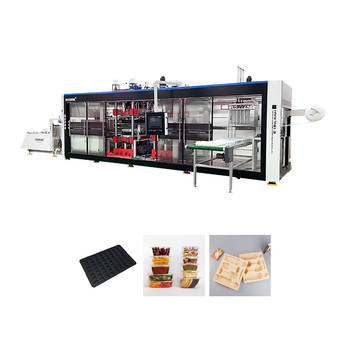
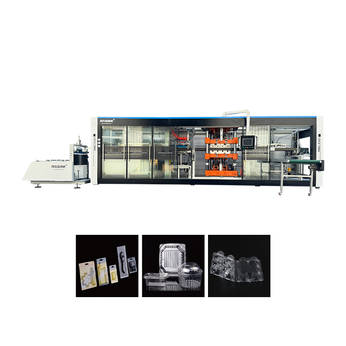
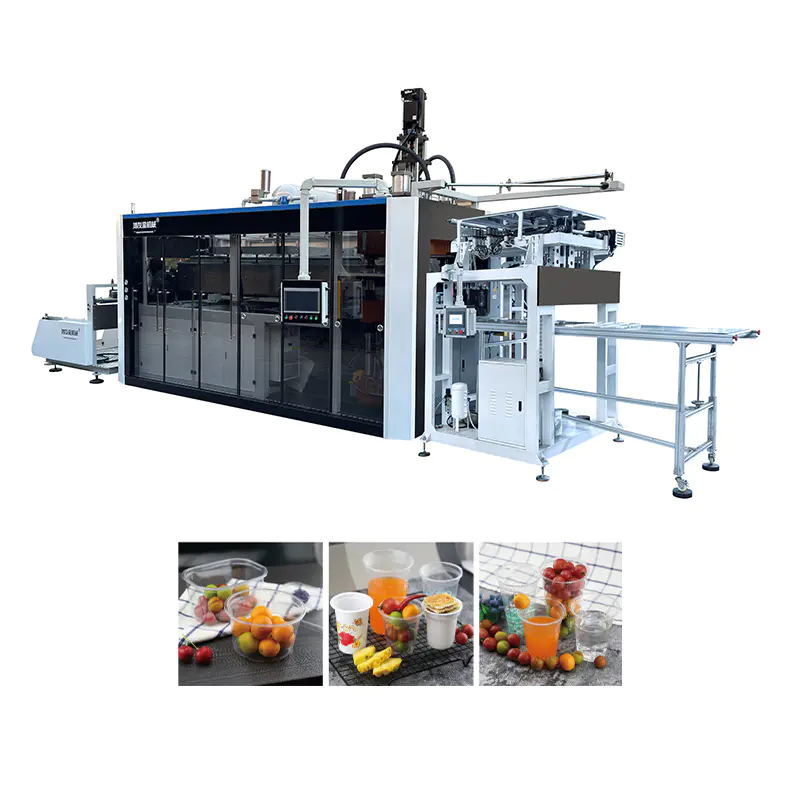
Figure: Integrated high-output thermoforming line with multi-cavity mould and high-speed stacking
Maximum output depends on cavity count, cycle speed, and cup size. A 16-cavity plastic cup making machine running at 32 cycles per minute can produce 61,440 cups per hour for a 200 ml cup. For larger containers (500 ml or more), the output decreases to 30,000-40,000 cups per hour due to longer heating and cooling times.
The thermoforming mould directly impacts cycle time through its cooling efficiency. A mould with optimized cooling channels can reduce cooling time by 20-30%, directly increasing output. Mould quality also determines cup wall thickness uniformity; a well-designed mould with balanced cavity-to-cavity variation below 0.03 mm will produce consistent cups with fewer rejects.
Plug-assist thermoforming enables the production of deep-draw cups (draw ratio > 1.5:1) with uniform wall thickness. Compared to vacuum-only forming, plug-assist reduces corner thinning by 50-70%, allowing the use of thinner sheet material. This reduces material cost by 15-25% while maintaining or improving cup strength. It is essential for tall cups and containers with complex geometries.
Trim-in-place technology eliminates the separate trimming step, reducing overall cycle time by 15-25% and improving trim accuracy from ±0.3 mm to ±0.1 mm. It also reduces labor costs and work-in-progress inventory. For high-output lines producing more than 20 million cups annually, trim-in-place typically pays for itself within 8-12 months through reduced scrap and increased throughput.
For a thermoforming mould operating at 30+ cycles per minute, a basic maintenance check should be performed every 2 weeks, including cavity surface inspection, cooling channel flow verification, and alignment measurement. A full overhaul, including cavity polishing, seal replacement, and cooling channel cleaning, should be scheduled every 6-12 months depending on production volume and material type.

 +8618621972598
  +8613917961988
  [email protected]
 No. 565, Xinchuan Road, Xinta Community, Lili Town, Wujiang District, Suzhou City, China
 Copyright © 2024 Thermoforming Machine/Plastic Cup Machine All Rights Reserved.Custom Automatic Vacuum Thermoforming Plastic Machine Manufacturers