

 English
 عربى
عربى 简体中文
简体中文
Home / News / Industry News / How Thermoforming Technology Shapes Medical, Electronic, and Packaging Products

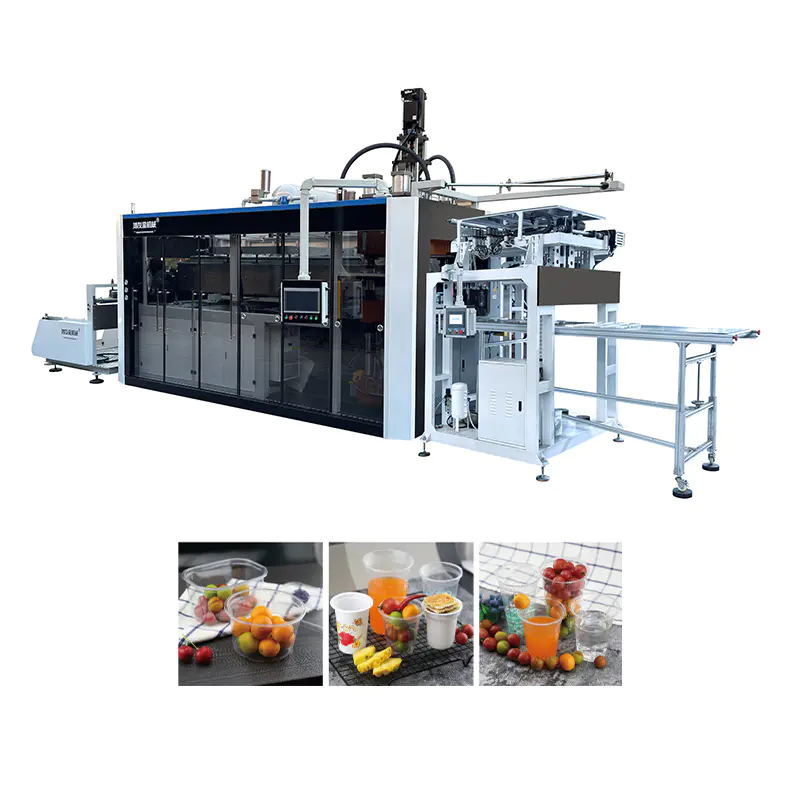
Thermoforming has quietly become one of the most versatile plastic processing methods used across industries that demand speed, repeatability, and design flexibility. Rather than being confined to a single product category, the process now supports a wide spectrum of outputs, ranging from single-use disposable items to structural components used in tightly regulated environments. Understanding where thermoforming fits into a broader manufacturing strategy helps engineers and buyers make more informed sourcing decisions.
At its core, thermoforming involves heating a plastic sheet until it becomes pliable, then shaping it over or into a mold using vacuum, air pressure, or mechanical assistance. The principle is simple, but achieving consistent wall thickness, tight tolerances, and clean surface quality requires careful control of sheet temperature, tooling design, and cycle timing. When these variables are managed well, thermoforming becomes a cost-efficient alternative to injection molding for parts that do not require extremely tight tolerances or complex internal undercuts.
Three sectors illustrate this versatility particularly well: medical device packaging, electronics component protection, and food or beverage service items. Each imposes different requirements on material selection, cleanliness, and dimensional accuracy, yet all rely on the same underlying forming principle described above.
Medical device packaging is one of the most demanding applications for thermoforming, since the packaging often functions as part of the sterile barrier system rather than simple product protection. Trays that hold surgical instruments, diagnostic kits, or implantable devices must maintain dimensional stability through sterilization cycles, resist puncture during transport, and allow controlled peel-open access in a clinical setting.
Material selection for medical thermoforming typically favors polymers with predictable, well-documented behavior under radiation or ethylene oxide sterilization. Because medical packaging is often produced in cleanroom or otherwise controlled environments, thermoforming lines serving this sector usually integrate additional filtration, static control, and inspection steps compared to general industrial forming lines.
| Material Type | Typical Use | Sterilization Compatibility | Notes |
|---|---|---|---|
| Rigid PETG | Instrument trays | Ethylene oxide, gamma | Good clarity, stable dimensions |
| High-impact polystyrene | Diagnostic kit trays | Ethylene oxide | Cost efficient, moderate stiffness |
| Medical-grade PVC | Blister packaging | Gamma, e-beam | Strong barrier properties |
| Polypropylene | Autoclavable trays | Steam autoclave | Higher heat resistance |
Regulatory expectations, including internationally recognized packaging standards for sterile barrier systems, push manufacturers toward extensive validation of seal strength, peel force, and dimensional consistency before a design reaches production volume. Thermoforming is often preferred over injection molding for these low-to-mid volume medical trays because tooling changes are comparatively fast and inexpensive, which matters when a device design goes through several revisions before final approval.
Printed circuit boards, connectors, and other sensitive electronic components require packaging that does more than hold a part in place. Static dissipative or conductive trays, typically produced from carbon-loaded polymer sheet, protect components from electrostatic discharge during handling, transport, and automated assembly. Pocket geometry is engineered around the exact component footprint so that parts do not shift or contact one another during vibration.
These trays are frequently designed for nesting and stacking, which reduces storage volume and supports high-speed automated pick-and-place lines. Wall uniformity becomes critical here, since a thin spot in a pocket wall can allow flexing that misaligns a component during automated handling.
Cycle times for electronics trays are usually shorter than for thicker medical trays, since sheet gauge is lighter and forming depth is often shallower. This allows manufacturers to run larger batches within a single shift while still holding tolerances suitable for automated equipment.
Beyond medical and electronics applications, thermoforming supports a broad range of general packaging and industrial handling products, from retail clamshells to reusable dunnage trays used in automotive parts logistics. The choice of forming method has a direct effect on achievable detail, wall thickness range, and part size.
| Forming Method | Typical Wall Thickness | Best Suited For | Detail Level |
|---|---|---|---|
| Vacuum forming | 0.5 to 3 millimeters | Large, shallow parts | Moderate |
| Pressure forming | 0.5 to 4 millimeters | Cosmetic panels, sharp detail | High |
| Twin-sheet forming | 3 to 10 millimeters combined | Hollow, rigid structures | Moderate |
Common packaging outputs include:
Industrial dunnage trays deserve particular attention because they are engineered for hundreds or thousands of reuse cycles rather than a single trip. This changes material selection toward tougher, more impact-resistant sheet stock, and often calls for reinforced rib patterns that would not be necessary in a disposable retail tray.
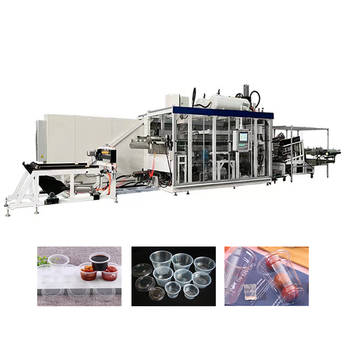
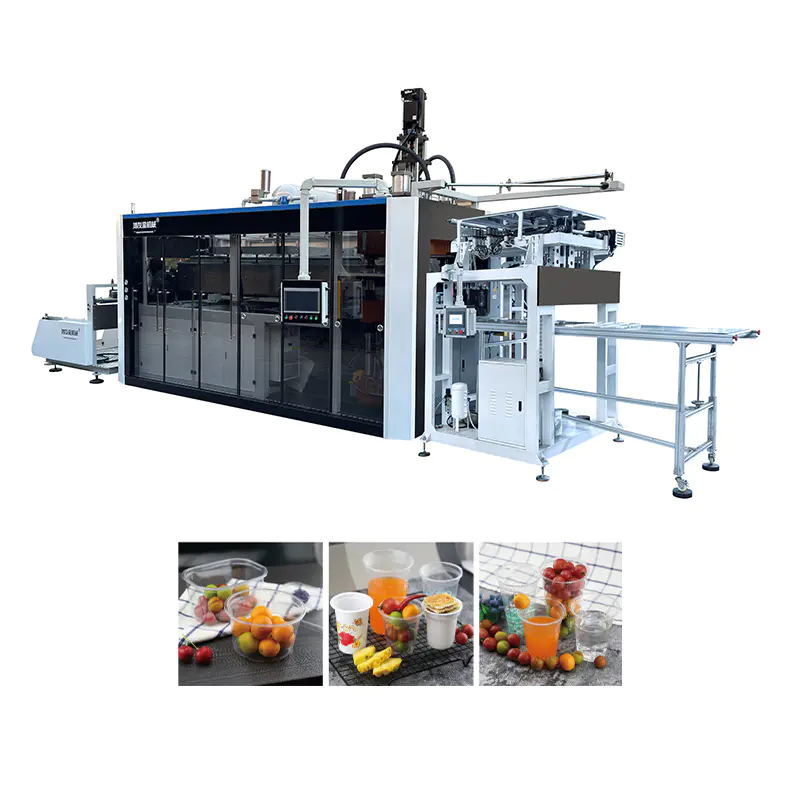
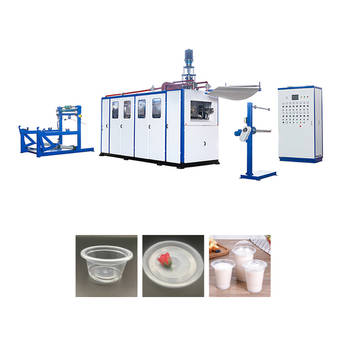
Food service cups, lids, and small containers represent a high-volume corner of the thermoforming world, distinct from the lower-volume medical and electronics trays described earlier. Producing these items efficiently generally requires a dedicated plastic cup making machine, built around continuous roll-fed sheet rather than individual cut sheets, since cup production runs are measured in tens of thousands of units per shift rather than hundreds.
These lines typically combine several stages within one continuous process: sheet unwinding, heating, forming, in-line trimming, and automatic stacking. Because cups are relatively simple in geometry compared to a component tray, cycle speed becomes the dominant design priority, and tooling is built with multiple cavities to maximize output per cycle.
Material choice for cup production commonly centers on polypropylene or PET sheet, chosen for a balance of clarity, stiffness, and food contact suitability. Businesses evaluating automated cup forming equipment generally weigh cavity count, stacking height consistency, and changeover time between cup sizes as the main factors that determine real-world throughput, rather than headline cycle speed alone.
Stacking height consistency in particular affects downstream packing automation. If cup wall thickness or rim geometry varies slightly between cycles, stacks can become uneven, which slows manual or automated bagging operations further down the line.
Moving from a concept sketch to a production-ready thermoformed part involves a series of interconnected decisions. Getting these right early avoids costly tooling revisions later.
Prototyping with lower-cost tooling before committing to a full production mold remains a practical way to validate fit and function without the full capital cost of hardened tooling.
Precision in thermoforming is relative to the application, and expectations differ sharply between a disposable cup and a medical instrument tray. The following ranges reflect general industry experience rather than any single production line.
Typically plus or minus 0.25 to 0.5 millimeters for standard trays, tighter with pressure forming
Ranges from matte industrial texture to high-gloss cosmetic finish depending on tool surface
Consistent tooling temperature control keeps part-to-part variation within design tolerance across a full run
Ranges widely, from a few seconds for thin cup stock to over a minute for thick industrial parts
Regular tool maintenance, sheet gauge consistency from the material supplier, and stable oven temperature profiles all contribute more to sustained quality than any single piece of equipment. Facilities that track these variables over time generally see fewer rejected parts than those relying on end-of-line inspection alone.
While details vary by machine type and product, most thermoforming operations follow a similar sequence of stages, illustrated below.
Each stage carries its own control points: sheet feeding must maintain even tension, heating requires zone-by-zone temperature control to avoid sagging or scorching, forming pressure and vacuum timing determine detail capture, trimming accuracy affects fit with mating parts, and final inspection catches thickness or cosmetic defects before packing.
Polystyrene, polypropylene, PET or PETG, and PVC are among the most widely used sheet materials, each chosen based on clarity, stiffness, chemical resistance, and end use requirements such as food contact or sterilization compatibility.
Thermoforming generally requires lower tooling investment and shorter lead times for large, shallow parts, while injection molding suits smaller parts needing very tight tolerances or complex three dimensional features.
Medical packaging must often function as part of a validated sterile barrier system, which adds requirements around seal strength, peel force consistency, and compatibility with sterilization methods that standard packaging does not need to meet.
Cup production typically runs on continuous roll-fed lines built for very high unit volumes and simple, repeatable geometry, whereas tray and component thermoforming often runs lower volumes with more complex pocket shapes and tighter tolerances.
Consistent sheet gauge from the material supplier, stable oven temperature profiles, and routine tooling maintenance tend to have a greater cumulative effect on quality than any single piece of equipment.

 +8618621972598
  +8613917961988
  [email protected]
 No. 565, Xinchuan Road, Xinta Community, Lili Town, Wujiang District, Suzhou City, China
 Copyright © 2024 Thermoforming Machine/Plastic Cup Machine All Rights Reserved.Custom Automatic Vacuum Thermoforming Plastic Machine Manufacturers