

 English
 عربى
عربى 简体中文
简体中文
Home / News / Industry News / How to Choose the Right Plastic Material for Thermoforming Machine Production

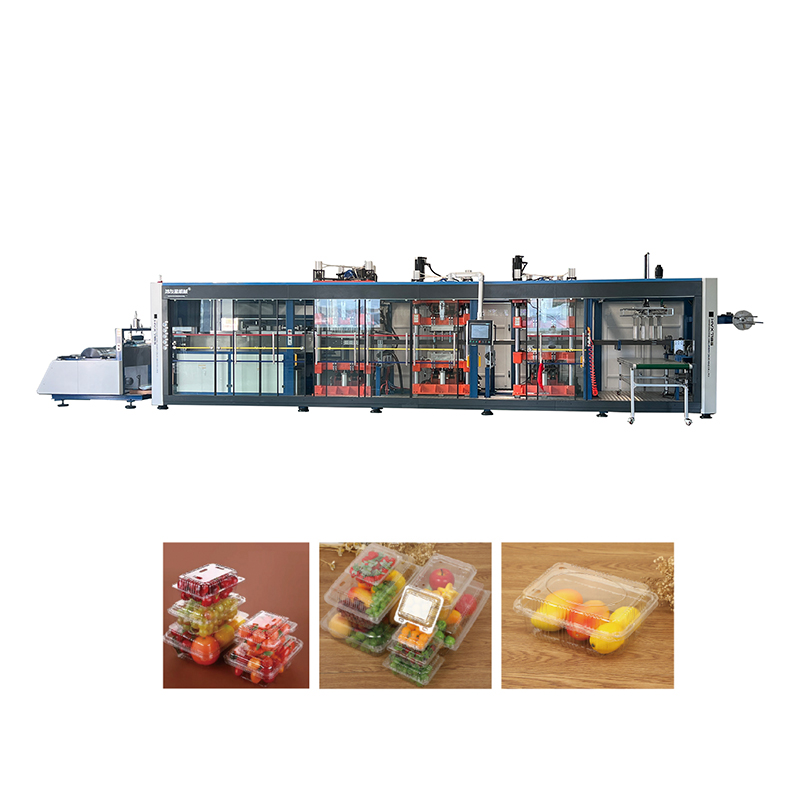
Every successful thermoforming run begins long before the sheet reaches the mold. The resin grade, its gauge, and its thermal behavior decide whether a part fills the cavity cleanly, holds its shape after cooling, and survives downstream handling. Operators who treat material selection as an afterthought often trace scrap-rate problems back to a mismatch between the plastic and the tooling, rather than a fault in the thermoforming machine itself.
This guide walks through the practical criteria for choosing among thermoformable plastics, with attention to cup, lid, and clamshell production where wall thickness and clarity are frequently non-negotiable requirements.
Manufacturers typically choose from a short list of resins for high-volume packaging work. Each behaves differently under heat and pressure, which changes how a part performs once it leaves the tool.
| Material | Clarity | Heat Resistance | Typical Cost Tier | Common Application |
|---|---|---|---|---|
| Polypropylene (PP) | Moderate | High | Medium | Hot-fill cups, microwaveable lids |
| PET | High | Moderate | Medium-High | Clear cups, clamshells |
| PS (Polystyrene) | High (GPPS) / Low (HIPS) | Low | Low | Cold-fill cups, disposable trays |
| PVC | High | Low-Moderate | Low | Blister packaging, rigid trays |
Screening candidates against this table early avoids costly rework, since switching resin families mid-project often means adjusting mold temperature settings and vacuum timing as well as reviewing types of thermoforming plastics already qualified for the tooling on hand.
Polypropylene forms a semi-crystalline structure that gives it a narrower processing window than amorphous plastics like PET or PS. Sheet temperature must be controlled tightly enough that the material softens uniformly without sagging excessively before it contacts the mold surface. Because PP does not signal readiness the way amorphous sheets visibly droop, many operators rely on infrared sensors and repeatable oven zone settings rather than visual judgment alone.
Sheet gauge is chosen based on the finished part's structural role, not simply rounded to a convenient number. A cup wall, a snap-fit lid, and a rigid clamshell each carry different load expectations.
| Product Type | Typical Sheet Gauge Range | Key Consideration |
|---|---|---|
| Disposable cups | Thin gauge, high draw ratio | Uniform wall distribution to prevent thin spots near the base |
| Snap-fit lids | Medium gauge | Enough rigidity at the rim to maintain seal engagement |
| Clamshell containers | Medium to heavy gauge | Hinge area needs flexibility without whitening or cracking |
Deep-draw parts stretch the sheet unevenly, so the starting gauge has to account for the thinnest point of the finished part, typically found at the base corners or near a hinge. Suppliers often provide draw-ratio guidance for a given resin so that thickness selection does not rely on trial and error alone.
Density affects both material cost and part behavior, since a denser resin generally yields fewer parts per kilogram of material purchased but may also provide better barrier properties or rigidity. When evaluating plastic density for molding, consider these factors together rather than in isolation:
A useful practice is to request a small trial run before committing to a full production order, since even resins within the same nominal density category can behave differently across mold geometries and cycle-time settings.
A structured evaluation sequence keeps material decisions consistent across projects, rather than depending on individual operator preference.
| Defect | Likely Material Cause | Prevention Approach |
|---|---|---|
| Thin base or corner webbing | Gauge too thin for the draw ratio required | Increase starting sheet thickness or reduce part depth |
| Cloudy or hazy walls | Resin grade with lower optical clarity under stress | Switch to a clarity-optimized grade of the same polymer family |
| Warping after demolding | Uneven cooling combined with high shrinkage resin | Adjust mold cooling time and confirm gauge uniformity across the sheet |
| Cracking at hinge points | Material too rigid for repeated flexing | Use a grade formulated specifically for hinge flexibility |
Following this sequence keeps thermoform materials selection grounded in measurable requirements rather than habit, which reduces the chance of late-stage tooling changes.
Polypropylene is semi-crystalline and requires a narrower, more tightly controlled heating window, while polystyrene is amorphous and forms over a broader temperature range. PP generally offers better heat and chemical resistance, while polystyrene typically provides higher optical clarity at lower cost.
Thickness is calculated backward from the thinnest acceptable wall at the deepest draw point of the part, factoring in the resin's typical draw ratio. Trial runs then confirm whether the calculated gauge holds up under actual line conditions.
Not necessarily. Density influences rigidity and barrier performance, but part strength also depends on wall thickness distribution, cooling uniformity, and the specific resin formulation, so density should be evaluated alongside these factors rather than alone.
The same mold geometry can often be used, but processing settings such as heating time, mold temperature, and cooling duration typically need adjustment when switching resin families to account for differing shrinkage and melt behavior.
Uneven wall thickness from an incorrect gauge-to-draw-ratio match is one of the most frequent causes, often showing up as thin basewalls or corner webbing that fails structural inspection.

 +8618621972598
  +8613917961988
  [email protected]
 No. 565, Xinchuan Road, Xinta Community, Lili Town, Wujiang District, Suzhou City, China
 Copyright © 2024 Thermoforming Machine/Plastic Cup Machine All Rights Reserved.Custom Automatic Vacuum Thermoforming Plastic Machine Manufacturers