

 English
 عربى
عربى 简体中文
简体中文
Home / News / Industry News / Single Station vs Shuttle Type Heavy Gauge Thermoforming Machines: How Each Configuration Impacts Production Efficiency, Cost, and Part Quality

When manufacturers face the challenge of producing large, durable plastic components from thick thermoplastic sheets, the choice of thermoforming platform fundamentally shapes production capability. Among the most widely deployed configurations for heavy gauge thermoforming machine applications are single station and shuttle type systems. Each represents a distinct engineering philosophy with direct consequences for cycle time, per-part cost, operational flexibility, and quality consistency.
Heavy gauge thermoforming, typically processing sheets from 1.5 mm to 12 mm and beyond, serves industries ranging from automotive interiors and appliance liners to medical equipment housings and industrial material handling products. Unlike high-speed thin-gauge packaging thermoforming, thick sheet processing demands higher heating capacity, robust clamping force, precise sag control, and often pressure-assisted forming to achieve acceptable wall thickness distribution in deep-draw parts.
This technical comparison examines single station and shuttle type thick sheet vacuum thermoforming machine configurations across operational parameters, financial justification models, and application suitability. The analysis draws on actual production data, thermal dynamic principles, and tooling economics to equip decision-makers with actionable selection criteria.
While both machine types perform the same fundamental sequence — sheet loading, heating, forming, cooling, and part removal — the arrangement and timing of these operations differ radically, dictating throughput potential and operational complexity.
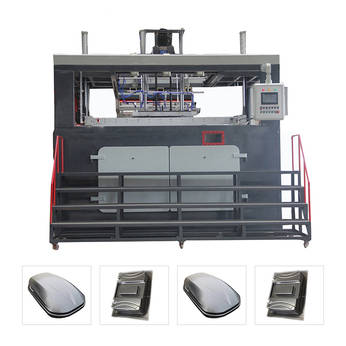
In a single station thick gauge vacuum forming machine, all process phases occur within one enclosed workspace. A pre-cut thermoplastic sheet, clamped along all four edges, remains stationary while overhead infrared heaters move into position to raise the material to forming temperature (typically 160°C to 220°C for materials like ABS or HDPE). After reaching target temperature, heaters retract, the mold platform rises to seal against the sheet, vacuum and/or positive pressure form the part, cooling fans or mist sprays solidify the plastic, and finally the finished product is unloaded. Every step occurs sequentially, and the machine remains idle during sheet changeover. This stop-start rhythm defines batch-style thermoforming: one complete cycle must finish before the next sheet is processed.
The shuttle-type heavy duty vacuum forming equipment decouples the heating and forming functions by introducing separate zones. The machine consists of a central forming station flanked by two heating stations positioned on opposite sides. While one sheet is being heated in the left oven, another sheet is being formed, cooled, and unloaded at the central station. The shuttle mechanism — a motorized carriage that carries the sheet in its clamping frame — moves the heated sheet laterally into the forming station, where the mold rises to perform the forming cycle. Meanwhile, the second heating station has already been loaded with a fresh sheet. As one formed part is removed, the next heated sheet is ready to be shuttled in, and the empty heating station receives a new sheet. Thus, while a single station machine spends roughly 60-75% of its total cycle time solely on heating (which cannot be overlapped with forming), the shuttle design allows heating to occur concurrently with forming, producing a near-doubling of net output in well-optimized setups.
According to published patent literature on shuttle-type systems, the speed of both machine types remains fundamentally governed by the sheet heating duration, but the shuttle configuration eliminates idle time between cycles because post-forming operations happen in parallel with pre-heating of the next sheet. Heating time for thick sheets (e.g., 4 mm ABS) typically ranges from 90 to 150 seconds depending on material type, heater density, and target forming temperature. In a single station machine, that entire heating period consumes the cycle time, plus forming, cooling, and handling overhead. In a shuttle machine, the forming and handling stages of one sheet occur while the next sheet is simultaneously being heated, effectively hiding the heating time within the overall process window.
The following table quantifies performance differences between single station and shuttle type configurations under identical processing conditions for a typical automotive interior panel (ABS, 3 mm thick, 1000 mm × 800 mm mold footprint).
| Parameter | Single Station (6.5 kW heating) | Shuttle Type (dual 6.5 kW stations) |
|---|---|---|
| Heating time per sheet | 110 seconds | 110 seconds (overlapped) |
| Forming + cooling time | 50 seconds | 50 seconds |
| Sheet change / clamp time | 15 seconds | 15 seconds (parallel) |
| Total effective cycle time | 175 seconds | 110 seconds (heating dictating pace) |
| Parts per hour (theoretical) | 20.6 pcs/hr | 32.7 pcs/hr |
| Annual output (6,000 hrs) | 123,600 parts | 196,200 parts |
| Productivity gain | Baseline | +58% |
| Energy per part | 1.15 kWh | 0.78 kWh |
| Floor space requirement | 12 m² (single station) | 18–24 m² (for two ovens + forming zone) |
The 58% productivity uplift for shuttle systems reflects the overlap of heating and forming operations, not any reduction in fundamental heating physics. However, this gain assumes consistently available operator attention and rapid tool changes; real-world shopfloor data shows net shuttle productivity improvements between 45% and 65% depending on part complexity and automation level. Notably, energy consumption per part declines by roughly 32% because heaters operate continuously rather than cycling on and off through idle periods, eliminating thermal mass reheating losses.
Throughput advantage remains the single most cited reason for selecting shuttle technology. A study of heavy gauge production lines across multiple industrial facilities indicates that a well-optimized shuttle thick sheet vacuum thermoforming machine achieves 45 to 55 cycles per hour for parts requiring moderate cooling, compared to 28 to 35 cycles per hour on a single station machine of equivalent sheet size and heater capacity.
For a manufacturer producing refrigerator inner liners — a classic thick-gauge application — the throughput difference translates directly to line capacity planning. A single refrigerator door liner typically requires 2 to 2.5 minutes total machine time per piece on a single station platform. On a shuttle machine producing identical parts, the line achieves 1.2 to 1.4 pieces per minute because the heating of subsequent sheets occurs while the previous liner is being formed and cooled. At 6,000 operating hours per year, the single station produces approximately 144,000 liners annually, while the shuttle type produces 257,000 pieces — an 80% increase in output without additional factory floor space beyond the machine footprint itself.
Manufacturers operating multiple shifts will find that shuttle technology defers or eliminates the need for parallel production lines. One shuttle machine can replace two single station machines producing the same part, yielding capital savings on secondary handling equipment, reduced labor requirements, and lower facility overhead. However, this calculation pivots on demand consistency: a shuttle line operating at 50% utilization due to part changeovers or maintenance may offer no economic advantage over simpler single station alternatives.
Key factors that influence net achievable throughput on shuttle systems include:
Tooling strategy differs meaningfully between the two machine architectures, influencing both initial capital expenditure and ongoing operating costs for mold maintenance and changeover.
Single station thermoformers typically employ simpler mold mounting systems. The mold bolts directly to a platen that remains stationary throughout the cycle. Because the sheet does not move horizontally after clamping, alignment precision requirements are less demanding. Mold construction for single station machines often uses cast or machined aluminum without elaborate cooling channel integration, since cooling is applied from external fans and mist jets rather than through-mold liquid circulation. This simplicity reduces per-mold cost by roughly 25-35% compared to the shuttle-compatible molds, making single station attractive for manufacturers who frequently change part designs or run small batches. For prototype runs or low-volume production, the lower tooling investment directly improves per-part economics.
Shuttle machines subject molds to more demanding operational conditions. The clamping frame must securely hold the sheet during lateral acceleration and deceleration as it moves between stations. Molds intended for shuttle production should incorporate robust alignment features — guide pins, tapered locators — to accommodate small positional variations from shuttle carriage wear. Additionally, the mold base must withstand the thermal cycling from repeatedly sealing against fully heated sheets transferred directly from the oven. Many shuttle installations use mold temperature controllers with integrated water channels to maintain consistent surface temperature across cycles, which adds to initial mold complexity but improves wall thickness consistency for deep-draw parts.
Single station machines excel at quick mold changes because the entire forming area remains accessible from the operator side. After disconnecting vacuum lines and cooling hoses, the mold can be lifted out and replaced within 20 minutes for a typical-sized heavy gauge tool. Shuttle systems, by contrast, locate the forming station in the center of the equipment, often partially surrounded by heater boxes and carriage rails. Mold access requires sliding the carriage mechanism to a maintenance position or removing protective guarding, increasing changeover time to 30 to 50 minutes under optimal conditions. Manufacturers producing high-mix, low-volume part families may find this changeover penalty unacceptable, even with the shuttle's throughput advantages.
Industry best practice suggests a threshold: if a production line changes molds more than once per shift, single station flexibility outweighs shuttle productivity gains. Conversely, if a line runs the same part for days or weeks, the shuttle's per-part energy and labor savings dominate the cost model.
While purchase price alone presents an incomplete comparison, understanding total cost of ownership over a five-year horizon reveals economic justification for each configuration.
A single station industrial thick sheet thermoforming machine with manual sheet loading and basic vacuum forming capability typically requires a capital investment 30% to 45% lower than a fully automated shuttle system of comparable forming area. The cost difference reflects additional components in shuttle machines: two separate heating stations with independent control systems, precision shuttle carriage and guide rails, safety interlock guarding, and more sophisticated PLC programming to coordinate overlapping sequences.
For a machine with 1,500 mm × 1,500 mm forming area, a single station unit may be priced around $85,000 to $120,000 depending on options, while a comparable shuttle machine ranges from $135,000 to $190,000. However, the shuttle configuration includes automatic sheet loading and part ejection as standard in most contemporary designs, whereas single station machines often require separate manual loading stations or add-on automation that erases much of the initial price advantage.
Analysis of operating costs for both machine types must account for energy consumption, labor, maintenance, and consumables.
Break-even analysis example: A manufacturer producing 150,000 parts annually on a single station machine would require a second shift or additional equipment. Upgrading to a shuttle machine adds $70,000 upfront capital but reduces per-part labor by $0.42 and energy by $0.09. At 150,000 parts per year, annual operating savings total approximately $76,500, achieving payback within 11 months. For annual volumes below 60,000 parts, the single station machine delivers lower total cost despite higher per-part variable expenses.
Quality metrics — dimensional accuracy, wall thickness uniformity, surface finish, and absence of stress marks — depend heavily on thermal uniformity and sheet handling precision. Each machine architecture introduces distinct quality characteristics and control challenges.
Because the sheet remains clamped on all four edges and does not move after initial positioning, single station machines provide superior sag control and registration accuracy for complex geometries. The enclosed forming chamber allows precise counter-pressure application to balance vacuum forces and achieve uniform thickness in deep-draw sections. For parts with intricate surface detail, fine textures, or multi-cavity molds requiring exact alignment, the single station's stationary sheet offers advantages that shuttle designs struggle to match without additional compensation mechanisms.
Quality engineers from appliance manufacturing plants report that single station equipment consistently holds wall thickness variation to within ±5% of nominal values for refrigerator liners, compared to ±8–10% on shuttle machines producing identical parts. The difference arises because shuttle-transferred sheets experience brief exposure to ambient air during lateral movement (typically 3–6 seconds), causing localized cooling at sheet edges that can produce thickness gradients in subsequently formed sections.
State-of-the-art shuttle machines incorporate several technologies to mitigate transfer-induced quality issues. Anti-sag control systems use infrared sensors to monitor sheet droop during heating, adjusting lower heater intensity or applying air pressure from below to maintain flatness. Some shuttle configurations heat sheets in a fully enclosed oven, withdraw the heater bank, and then immediately shuttle the sheet into the forming station, with total transfer time under two seconds. This reduces edge cooling to acceptable levels for most applications except those requiring extremely tight tolerances.
Pressure forming — applying up to 5–6 bar of positive air pressure on the sheet side opposite the mold — is more readily implemented on shuttle machines because the forming station remains isolated from heating zones. This allows deeper draws and sharper definition without the risk of pressure leaks affecting heater components. For thick sheet parts requiring complex three-dimensional shapes, shuttle machines equipped with pressure forming capability frequently achieve surface detail indistinguishable from injection molded components at a fraction of the tooling cost.
Modern PLC-controlled custom heavy gauge thermoforming equipment in both configurations includes comprehensive data logging of heating profiles, vacuum pressure curves, and cooling rates. However, shuttle systems demand more sophisticated temperature control because two heating stations must operate identically to ensure consistent sheet conditioning. Calibration drift between stations can produce inter-batch variation: parts formed from the left oven may exhibit different material distribution than those from the right oven. Manufacturers implementing shuttle lines typically invest in monthly heater calibration and pyrometer verification to maintain process capability indices (Cpk) above 1.33.
The following decision matrix summarizes which machine type typically delivers superior economic and quality outcomes for common heavy gauge thermoforming applications based on production volume, part complexity, and changeover frequency.
| Application Category | Typical Annual Volume | Recommended Configuration | Rationale |
|---|---|---|---|
| Automotive interior panels (single model) | 50,000–200,000 units | Shuttle type | Volume justifies automation; throughput gains critical for JIT supply. |
| Automotive interior panels (multiple model variants) | 5,000–30,000 units per variant | Single station | Frequent tool changes dominate; single station offers changeover speed. |
| Refrigerator liners / door liners | 100,000–500,000 units | Shuttle type | High volume; large sheet sizes benefit from continuous heater operation. |
| Medical equipment housings (multiple SKUs) | 500–5,000 units per design | Single station | Low volume per design; prototyping needs; lower tooling cost per mold. |
| Material handling pallets / containers | 10,000–50,000 units | Single station or shuttle | Depends on pallet complexity; simple shapes may be fine with single station. |
| Large bathtubs / spa shells | 500–2,500 units | Single station | Extremely large tooling; transfer handling risks damage; quality priority. |
| Aerospace cabin components | 100–1,000 units | Single station | Low volume; exacting quality; long mold setup acceptable. |
| Heavy truck interior trim | 20,000–80,000 units | Shuttle type | Moderate volume; shuttle provides cost-efficient scaling. |
Automotive interior panel production illustrates the volume-dependent choice: a Tier 1 supplier producing door panels for a single high-volume vehicle platform (150,000 units per year) will select shuttle technology for its 58% throughput gain and lower per-part energy consumption. However, a specialty commercial vehicle manufacturer producing 8,000 door panels annually across 12 different model variants will find single station equipment more economically rational, as tool changeover time on a shuttle machine would consume an unacceptable fraction of available production hours.
Real-world production data from thermoforming facilities illustrates the practical implications of the single station versus shuttle decision across different market segments.
A white goods manufacturer operating seven thermoforming lines produced ABS refrigerator inner liners of approximately 1,600 mm × 900 mm using 3.5 mm thick sheet. The facility originally employed single station machines, achieving 32 completed liners per hour per line. After retrofitting two lines to dual-heating-station shuttle configuration while preserving the same mold set, the output increased to 52 liners per hour — a 62.5% productivity improvement. The per-part energy consumption declined from 1.48 kWh to 0.97 kWh. Over 5,000 operating hours annually, each converted line produced an additional 100,000 liners without additional floor space or headcount, justifying the $95,000 conversion cost within eight months of operation.
A manufacturer of instrument panel carriers initially selected single station equipment to accommodate frequent design iterations during vehicle model development. As production stabilized after two years and annual volume reached 110,000 units, the facility replaced three single station lines with two shuttle machines. The shuttle configuration utilized identical forming area but added automatic sheet feeding and a robotic part extractor. Despite losing one machine unit, the line's net output increased from 98 parts per hour to 112 parts per hour, while operator headcount dropped from six to three across two shifts, reducing direct labor cost by $180,000 annually.
A medical equipment OEM producing diagnostic instrument housings in batches of 400 to 2,000 units evaluated both technologies and selected single station automatic thick sheet thermoforming machine platforms. Despite higher per-part energy cost and slower throughput, the single station solution allowed mold changeover in under 25 minutes without specialized tools. The company produces 35 distinct housing designs annually, each requiring 2–4 production runs. Shuttle changeover time projections of 45–60 minutes would have added 35 hours of non-productive downtime annually across all designs, reducing available production capacity by 8% — a penalty that outweighed any throughput advantages for their specific manufacturing scenario.
Organizing the technical comparison into concise advantage and limitation statements supports rapid initial assessment before detailed financial modeling.
The selection between single station and shuttle type heavy gauge thermoforming machines represents a strategic manufacturing decision with consequences extending beyond the equipment purchase. The most appropriate choice depends on five critical factors: production volume expectations, part mix complexity and changeover frequency, available floor space and labor resources, quality requirements particularly for deep-draw geometries, and capital availability for automation investment.
Manufacturers should consider single station platforms when annual volume remains below approximately 60,000 parts, when product mix includes more than ten distinct part numbers requiring regular mold changes, when parts involve extremely deep draws or fine surface textures demanding stationary sheet forming, or when initial capital constraints limit equipment budget. Single station machines also serve effectively as development tools for new product introductions, with molds transferred to shuttle lines after demand stabilizes at volume.
Shuttle type equipment becomes economically superior at annual volumes exceeding 100,000 parts, particularly for dedicated production lines running identical part numbers for extended periods. The reduced per-part labor and energy costs, combined with higher throughput, typically achieve payback within 12 to 24 months compared to single station alternatives. Manufacturers pursuing Industry 4.0 integration and automated production cells will find shuttle platforms more compatible with robotic part handling and downstream finishing equipment.
Neither configuration universally outperforms the other. Smart manufacturers maintain hybrid capabilities: single station machines for low-volume, high-complexity work and prototyping, with shuttle lines dedicated to high-volume production of mature part designs. This combined approach maximizes overall equipment effectiveness across the full spectrum of heavy gauge thermoforming applications, from short-run specialty components to million-part automotive and appliance production contracts. The thick sheet vacuum thermoforming machine platform can be customized across either configuration, ensuring that manufacturers match equipment architecture directly to their specific product and operational requirements.
Heavy gauge thermoforming machines typically process thermoplastic sheets from 1.5 mm up to 12 mm, although some specialized equipment handles materials from 0.8 mm to 15 mm depending on material type and part geometry. ABS, HIPS, HDPE, polycarbonate (PC), and acrylic (PMMA) are the most commonly processed materials in this thickness range. Thicker sheets require proportionally longer heating cycles and more powerful vacuum systems to achieve complete mold replication.
Molds for single station machines typically cost 25–35% less than shuttle-compatible molds because they require simpler alignment systems and less robust thermal management. Single station molds can utilize cast aluminum without integrated water channels, while shuttle molds often incorporate guide pins, tapered locators, and temperature control passages to accommodate the moving sheet and thermal cycling. However, the per-part amortized tooling cost depends primarily on production volume, not absolute mold price.
Yes, most shuttle machines can be operated in a manual or semi-automatic mode that effectively functions as a single station unit. Operators can load a sheet, heat it in one oven, shuttle it to the forming station, and complete the cycle without using the second oven. However, this operational mode does not bypass the longer mold changeover time inherent to the shuttle design, and the machine's higher capital cost remains unrecovered at low output levels.
Facility-level data from multiple thermoforming operations indicates energy savings of 20–28% per produced part after converting from single station to shuttle equipment. The improvement arises primarily from continuous heater operation in shuttle systems, eliminating the thermal mass reheating losses that occur when single station heaters cycle fully off between sheets. For a facility consuming 400,000 kWh annually on thermoforming, switching to shuttle technology would reduce consumption by approximately 90,000 kWh, representing $9,000–$13,000 annual savings at typical industrial electricity rates.
Both configurations can be equipped with pressure forming capability, but shuttle machines offer practical advantages for this process. Pressure forming applies 4–6 bar of positive air pressure from the sheet side opposite the mold to achieve sharper detail and deeper draws. Isolating this pressurized chamber from the heating zone — naturally accomplished in shuttle design due to separate stations — simplifies equipment design and reduces seal maintenance. Single station pressure forming requires movable partitions or retractable seals that increase mechanical complexity.
Single station machines generally achieve tighter dimensional tolerances and more uniform wall thickness, particularly for deep-draw geometries. The stationary sheet eliminates transfer-induced cooling differentials and sag variations. However, modern shuttle machines equipped with anti-sag control and rapid transfer mechanisms (under two seconds from oven to mold) produce quality levels acceptable for all but the most demanding aerospace or precision medical applications. For typical automotive, appliance, and industrial part requirements, both configurations deliver conforming quality when properly maintained and operated.
Single station machines require basic preventative maintenance every 500 operating hours: vacuum system inspection, heater calibration, pneumatic cylinder lubrication, and electrical connection verification. Shuttle machines demand more intensive attention to carriage components — drive belts or chains, linear bearings, limit switches, and flexible vacuum hoses — typically requiring inspection every 250 hours and component replacement at 2,000 hour intervals. Annual maintenance costs for shuttle equipment average 60–80% higher than single station machines operating similar schedules.
ROI analysis varies significantly with annual production volume. At 100,000 parts per year with moderate labor costs ($25/hour), shuttle equipment typically achieves payback within 12–18 months. At 200,000 parts annually, payback compresses to 8–12 months. Below 50,000 parts annually, the initial capital premium for shuttle equipment may never be recovered through operating savings, making single station the more economically rational choice. Manufacturers should run scenario analysis using their specific labor rates, energy costs, and projected volumes before final equipment selection.
Generally, molds designed for single station machines require modifications for shuttle compatibility. Single station molds typically lack the alignment features — guide pins, tapered locators, and hardened mounting surfaces — needed to withstand the lateral forces and positional tolerances of shuttle operation. Additionally, single station molds seldom include integrated cooling channels, which become more important for shuttle machines running at higher cycles per hour. Manufacturers transitioning from single station to shuttle should budget for new mold sets or significant tooling retrofits, typically 30–50% of original mold cost.
Single station machines present a simpler learning curve for new operators. The sequential process and direct visual access to the forming area make troubleshooting straightforward. Shuttle machines require operators to understand overlapping cycles, coordinate loading and unloading timing, and maintain two heating stations simultaneously. Training time for shuttle equipment typically requires 40–60 hours of supervised operation versus 16–24 hours for single station machines. Facilities with high operator turnover or limited training resources should factor this into equipment selection decisions.

 +8618621972598
  +8613917961988
  [email protected]
 No. 565, Xinchuan Road, Xinta Community, Lili Town, Wujiang District, Suzhou City, China
 Copyright © 2024 Thermoforming Machine/Plastic Cup Machine All Rights Reserved.Custom Automatic Vacuum Thermoforming Plastic Machine Manufacturers