

 English
 عربى
عربى 简体中文
简体中文
Home / News / Industry News / How Do Thermoforming Material Properties Affect Your Final Part Quality?

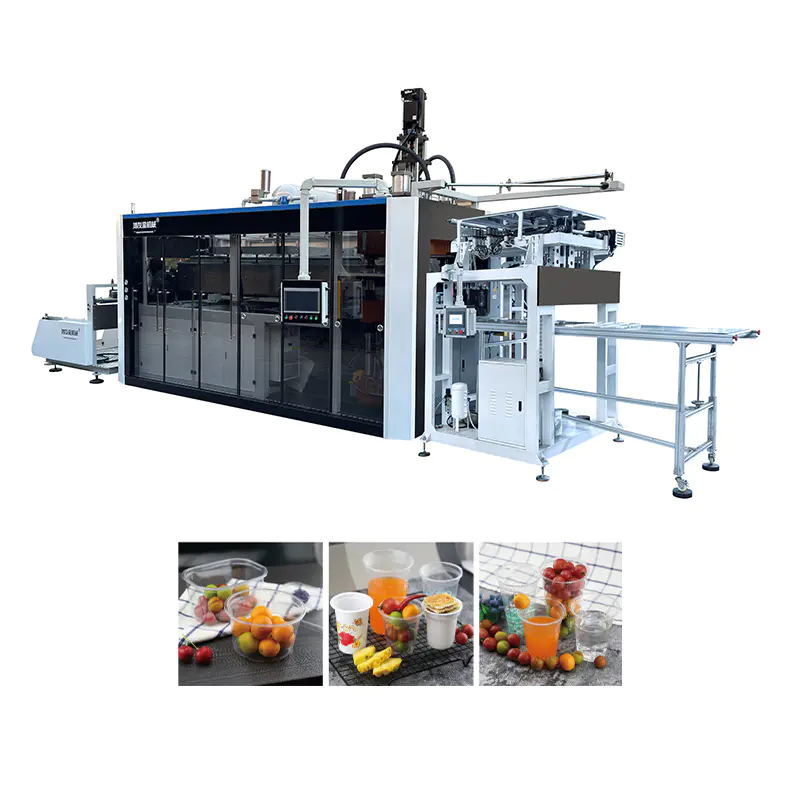
In the thermoforming ecosystem, the sheet is not a passive substrate—it is an active process variable. More than 60% of forming defects trace back to either gauge inconsistency or mismatched thermal response. This guide dissects the physical and mechanical boundaries of common thermoforming plastic sheet families, offering process engineers a decision framework grounded in data, not intuition.
Key insight: The Thermoforming Machine settings must be dynamically adjusted to the sheet's specific heat capacity. Ignoring this relationship leads to webbing, thinning, or stress whitening—all avoidable with correct material pairing.
The molecular architecture dictates how a sheet softens, flows, and cools. Amorphous polymers like High-impact polystyrene (HIPS) for thermoforming exhibit a broad glass transition, offering a wide processing window. Semi-crystalline PET, conversely, has a sharp melting point, demanding precise plastic sheet heating temperature control.
The chart above illustrates why thermoformable plastic selection hinges on thermal gradient management. PET requires narrower temperature bands, while HIPS offers forgiving processing.
Gauge variation directly affects wall thickness distribution in the final part. Even a 5% variance can cause a 15% reduction in burst strength. Material gauge consistency is not a spec sheet number—it is a process capability metric. The following chart shows the impact of gauge tolerance on part weight for a 2mm sheet.
Data from a 1,000-part production run shows that sheets with material gauge consistency within ±2% yield 97% first-pass quality. Tolerances beyond ±4% increase scrap rates by 22%.
Plastic sheet heating temperature is the most influential parameter. For PET, the recommended core temperature is 130-150°C, with surface temperature not exceeding 160°C to avoid crystallisation. HIPS operates between 140-180°C with a wider tolerance. The following flowchart guides the heating setup.
This flow reduces setup time by 40% and eliminates trial-and-error heating cycles. Always preheat the thermoforming sheets gradually to avoid thermal shock.
Selecting between HIPS and PET involves trade-offs. The table below summarises key performance indicators based on a 500-part production analysis.
| Property | HIPS | PET |
|---|---|---|
| Forming Temperature (°C) | 140-180 | 130-150 |
| Clarity (%) | 85 | 92 |
| Impact Strength (kJ/m²) | 8-12 | 6-9 |
| Chemical Resistance | Moderate | Excellent |
| Cost Index | 1.0 | 1.4 |
For food packaging, PET's clarity and barrier properties are preferred. For industrial trays, HIPS offers better cost-performance ratio.
The journey from raw thermoformable plastic to a finished component involves multiple steps. The following diagram illustrates the process flow with critical control points.
Each step interacts with sheet properties. For instance, PET sheet properties like crystallinity affect cooling rate, while HIPS requires longer preheat to ensure uniform sag.
Webbing: Caused by excessive sheet sag or uneven heating. Solution: Reduce heating time by 15% and increase clamp force.
Thinning: Occurs when sheet temperature is too high or draw ratio exceeds material limits. Maintain plastic sheet heating temperature within recommended range.
Stress whitening: Indicates over-stretching near the Tg. Use slower forming speed and slightly higher temperature.
The optimal core temperature for PET is between 130°C and 150°C. Surface temperature should not exceed 160°C to prevent crystallisation and haze formation. Use infrared thermometers to monitor both core and surface.
Gauge variation directly translates to thickness distribution. A ±3% tolerance can cause up to 12% variation in wall thickness, affecting structural integrity. Premium sheets maintain ±2% for consistent forming.
Yes, HIPS is FDA-compliant for food contact when properly formulated. However, PET offers better clarity and barrier properties, making it preferred for transparent packaging.
Tg marks the temperature where the polymer softens. For HIPS, Tg is around 100°C, while PET's Tg is ~75°C. Forming should occur well above Tg to ensure adequate flow and relaxation.

 +8618621972598
  +8613917961988
  [email protected]
 No. 565, Xinchuan Road, Xinta Community, Lili Town, Wujiang District, Suzhou City, China
 Copyright © 2024 Thermoforming Machine/Plastic Cup Machine All Rights Reserved.Custom Automatic Vacuum Thermoforming Plastic Machine Manufacturers